
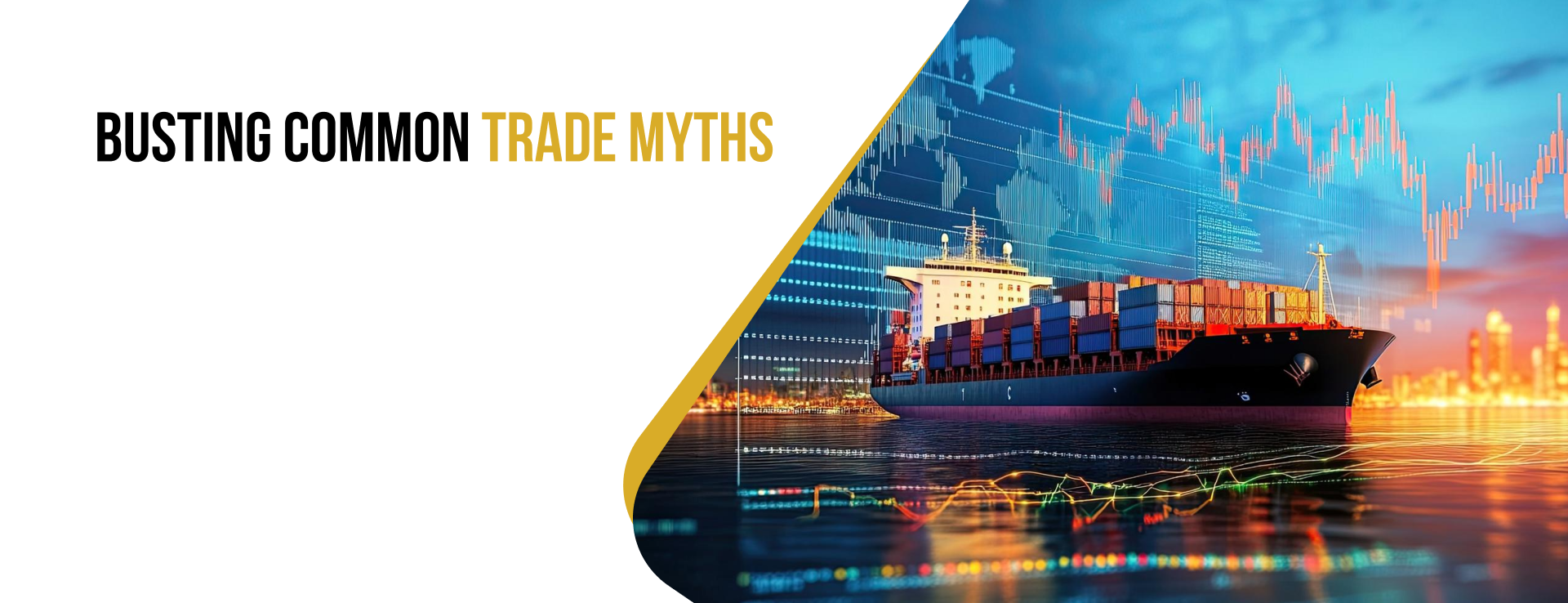

Trade Myths vs Reality: What Every Exporter Should Know
International trade comes with lots of advice, some of it comes with years of experience, while some gets repeated so often that people start treating it as a fact. This "common knowledge" often sounds convincing, but when applied to the chaotic, real-world dynamics of global logistics and cross-border negotiations, it can lead businesses down a very expensive path.
Markets evolve, buyer expectations shift, and global supply chains rarely function the same way for every business. What worked for one exporter may not work for another. Yet many businesses continue making important decisions based on assumptions.
Trade myths and reality have always been an eye-opening experience, and in most cases, trade myths can even be more misleading than trade reality. Understanding these myths will be very helpful in making better decisions and avoiding costly mistakes. Let's look at some of the biggest trade myths and see what the reality actually looks like.
Why Trade Myths Can Be Costly?
Believing the wrong assumptions can lead your business into the wrong direction. They turn into poor decisions which turn into missed opportunities. Certification badges might open the door, but an exporter who expects them to close the deal alone will quickly find that trust is still the only true currency in international trade. One who assumes every inquiry is worth chasing ends up wasting weeks on leads that were never serious. Unrealistic expectations set in early, usually right before the real costs show up - customs delays, failed shipments, a market entry that never earns back what it cost. This is exactly why international trade rewards businesses that validate assumptions with data.
Trade Myths vs Reality
1. Exporting Automatically Means Higher Profits
One of the most common examples of trade myths vs reality is the belief that exporting automatically increases profit. But the thing here to understand is revenue and profit are not the same thing. This myth affects exporters more than almost any other on this list. A bigger sale abroad often comes with freight costs, import duties, export packaging requirements, and certification fees that never show up on a domestic order. You need to see if the increase in sales is not only accompanied by an increase in revenue but also by healthy margins. The whole point is that an increase in revenue alone is not the main thing. You should really concentrate on how much you get in return for your expenses and the time devoted to a particular activity.
2. International Buyers Always Pay Better
This sounds reasonable but in reality international buyers often negotiate harder as they expect bulk discounts. They compare quotes against competitors in three other countries, not just the one next door. Payment terms also stretch longer too, sometimes 60 or 90 days instead of the 30. What actually decides profitability is total landed cost, not the number on the invoice. Evaluate the deal on what lands in your account after freight, duties, and payment delays, not the selling price alone.
3. More Export Markets = More Growth
Expanding the business into ten countries sounds like ambition. But it’s often just ten sets of regulations, multiple marketing approaches, and more customer support expectations, all managed by the same small team. Operational complexity scales faster than most people expect, and it scales badly. Sometimes three well-chosen markets outperform ten scattered ones. Building long-term relations and understanding local demand often delivers better results. The takeaway is to focus on well-chosen markets for a sustainable growth.
4. Certifications Guarantee Export Success
Certifications open doors for you but they don’t guarantee results. A buyer might shortlist you because of an ISO or GMP certificate, but they're still looking at quality, pricing, delivery reliability, and service on top of that. Certifications remove one barrier. They don't remove the rest of the sales process. One thing to understand is that a certified supplier with inconsistent deliveries is less attractive than a reliable supplier that consistently meets buyer expectations.
5. The Lowest Price Always Wins
If you believe that exporting cheaper products means more contracts, you are dead wrong. Smart buyers understand that there can be different issues behind the tag of "cheap commodity". Buyers who had a bad experience with suppliers who provided poor-quality goods previously now look for suppliers who can offer consistent quality, deliver on time, and are dependable in the long term. A mid-range supplier who never misses a deadline often beats the "cheapest" one every time.
6. Exporting Is Only for Large Companies
This is one of the common myths small to medium size traders think that exporting is for large businesses only. But the truth is that plenty of small and mid-size companies export successfully without ever owning a big warehouse. The digital marketplaces and trade platforms have made the job easier. It has lowered the entry barrier considerably, and government incentives in many countries specifically target SME exporters. Size helps with scale, but it was never a requirement to start. Real success depends on supplying the right products, understanding the target audience, and building a strong export strategy.
7. Finding Buyers Is the Hardest Part
Finding a buyer feels like the finish line when you're new to exporting. It's actually closer to the starting gun. Closing the deal, maintaining consistent quality across shipments, building enough trust that a buyer reorders, and managing that relationship long-term - that's where most of the real difficulty sits. The first inquiry is often the easy part.
8. Trade Data Is Only for Large Businesses
This is one of the biggest misconceptions in international trade. The reality is that trade data is now accessible to businesses of all sizes. Especially the SMEs, they can use trade data to find potential buyers, analyze competitors, track shipments, and much more - these factors help them to compete more strategically.
9. Trade Documentation Is Just Paperwork
Treating documentation as an afterthought is one of the more expensive mistakes on this list. The right paperwork is the one that ultimately helps you clear customs, keeps you compliant with relevant regulations and enables timely payment. Only an honest and correct HS code together with all the required paperwork will ensure smooth sailing of import/export. Any deviation from the required standards may result in delay, penalty or rejection of the goods. These kinds of mistakes do not stay confined to the area of their origin; they can cause the whole operation to come to a standstill.
Wrapping Up
Understanding trade myths vs reality helps you avoid costly mistakes and build a sustainable business. It isn't just a fun comparison, it's the gap that decides which exporters grow steadily and which ones burn cash chasing assumptions that are not correct. There is not a single export strategy for a successful export but comes from balancing profitability, compliance, market selection, buyer quality, and accurate execution.
The smartest exporters focus on evidence rather than assumptions. They do the proper market research, verify opportunities, monitor competitors, and take decisions with a long-run perspective. If you're an exporter looking to validate a market, verify a buyer, or check what your competitors are actually shipping, import export data gives you a real answer instead of a guess. Book a demo to see how trade data can sharpen your next move!
Frequently Asked Questions
1. What are the common international trade myths?
Some of the most common international trade myths include believing that exporting always leads to higher profits, international buyers always pay more, certifications guarantee success, and only large businesses can export.
2. Does exporting always result in higher profits?
No, definitely not always. Exporting may be a good way of adding revenue though the profits may be eaten up by the costs of export such as freight charges, customs duty certificates packaging, etc. as well as fluctuations in the currency. Because of this, a successful export business is not measured for selling alone but also for total profitability.
3. How can trade data help exporters?
Trade data helps exporters in finding active buyers, analyse competitor shipments, monitor market demand, and find new opportunities. You can get reliable import export data in platforms like EX-IM By The Dollar Business.
4. Is trade data useful for small exporters?
It's genuinely useful for businesses of any size. SMEs use trade data to find buyers, study competitors, and track shipment trends - work that used to require a dedicated research team.
Recent Blogs

Best Products to Export Based on Global Demand 2026
Discover best products to export in 2026 based on global demand and market opportunities Identify highdemand products and top export markets
India’s Import Export Data: Everything You Need to Know in 2026
Trade data isn't just numbers Discover how Indian businesses use importexport data to find buyers track competitors and much more in 2026
CIF vs FOB vs EXW Explained for Beginners
CIF vs FOB vs EXW explained for beginners learn what each Incoterm means who pays for what and when risk transfers in international shipping