
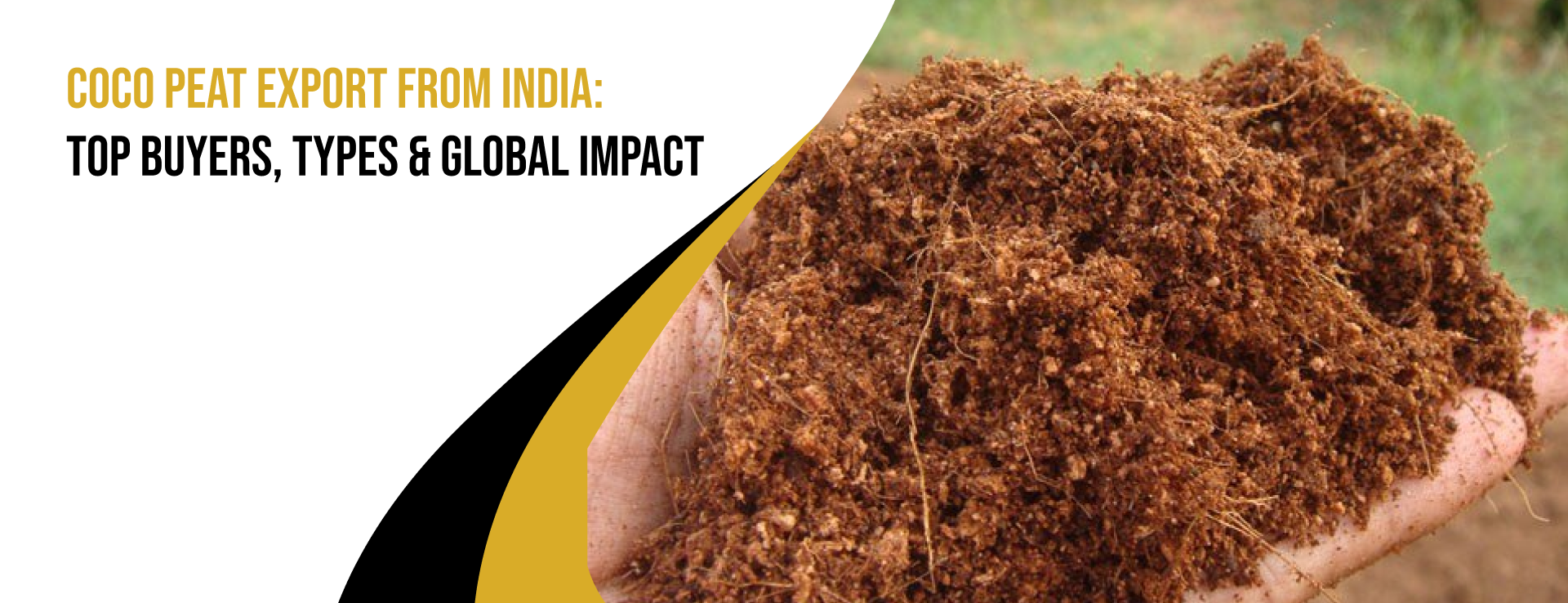

How Coco Peat Export from India is Transforming Global Agriculture
Key Highlights:
-
India now comes among the top three global coco peat exporters
-
Coco peat holds up to ten times its own weight in water while maintaining high porosity
-
Brazil leads global coco peat imports from India in 2025 with over $3.2 million in purchases
-
Indian exporters now use technologies like AI-powered moisture sensors and automated sieving systems that ensure up to 95% particle precision
-
India exports raw coir fibre, compressed blocks, coir yarn, and specialized coir products, giving buyers across different industries and budgets a suitable option
Indian coco peat has moved from being a by-product to becoming a serious global contributor. For decades, it was just seen as a by-product, but today, that "waste" is now filling a gap that modern agriculture could not ignore. Many in the industry now refer to it as a kind of sustainable “gold,” not because of hype, but because of how consistently it solves real farming problems.
India has now secured its position as one of the top three players in the global coco peat export market, with its exports valued at over $400 million. This shift is not accidental. It’s the result of rising global demand for cleaner, reliable, and water efficient growing mediums-and India is filling that gap with speed and scale.
Global Importance of Coco Peat
The global agriculture sector is under pressure and the major reason is sharp depletion of peat moss reserves especially in Europe. It causes environmental damage during extraction as it takes years to regenerate, plus the ecological cost is high. Another growing issue is soil degradation and chronic water scarcity forcing cultivators to look for alternatives that use less water. At the same time, agriculture is moving indoors, into greenhouses and controlled systems where consistency matters more than ever.
This is where coco peats fit naturally. It holds up to ten times its weight in water while maintaining high porosity, making it the perfect solution. Trends do not drive the demand. It comes from a clear need for better alternatives.
Where is Indian Coco Peat Going?
Indian exporters aren’t shipping to one market, they’re supplying to a global number of markets who’re in need. The below is the list of top coco peat importers who bought from India during year 2025:
| Top 5 Coco Peat Importing Countries (2025) | Value (USD) |
| Brazil | $3,299,128.33 |
| Malaysia | $738,296.95 |
| Mexico | $647,019.56 |
| Armenia | $451,267.2 |
| Russia | $413,770.4 |
The data clearly shows that Indian coco peat export is not limited to a single region but is spread across diverse global markets. Brazil is the leading country in 2025 to import coco peat with value $3,299,128.33. This indicates strong demand from its expanding agricultural sector. Countries like Malaysia and Mexico also feature prominently on the list.
The steady demand here comes from greenhouse farming, and the sustainable cultivation process. While Armenia and Russia, which are smaller in comparison, highlight how emerging and niche markets are increasingly turning to Indian coco peat to support their agricultural needs. Supplying to different markets won’t just reduce risk but also strengthens India’s position as a reliable global supplier in the coco peat industry.
Different Forms of Coco Peat Exported from India
India’s coco peat exports go beyond just one standard product. Each of them suits different agricultural and industrial needs across global markets.
| HSN Code | Category |
| 5305 | Coconut Coir fibre |
| 53050040 |
Coco peat blocks |
| 5308 | Yarn of vegetable fibre |
| 53050090 | Other Coir Products |
Raw coir fibre is often shipped to buyers who want to customize the product themselves especially in large-scale manufacturing countries. On the other hand, compressed coco peat blocks are designed for efficiency. They expand several times to their original size when hydrated, making these blocks suitable for shipping over long distances and heavy use. Coir yarn and other coir-based products are examples of more processed forms that can be used specifically for soil erosion control, production of horticultural mats, and eco-friendly packaging. These product varieties help Indian exporters to meet a wide range of buyers from very large agricultural importers or specialized industrial users.
Coco Peat’s Role in Modern Farming
Modern farming methods now involve more controlled and high-precision agriculture. This is visible in hydroponics, vertical farming, and greenhouse cultivation. These farming methods follow the same growing medium which holds water without suffocating roots, maintain air gaps, and consistent structure in multiple crop cycles. One more important advantage is that it fulfills organic farming requirements which have less chemical usage. Since coco peat is a natural by product, it supports the move towards safer and more traceable farming. By exporting standardized coco peat products, India is influencing how modern farms are set up globally. The input may be simple, but its impact is consistent.
What Makes Indian Peat Stand Out?
Indian coco peat is competitive because exporters have upgraded very quickly, they’ve moved from sun-drying basic processing methods and are now focusing on precision and consistency. The key factors that make Indian peat stand out are:
| S. No | Factors | What it Means | Why it Matters |
| 1 | AI-powered moisture sensors | Advanced sensors control and monitor moisture levels during processing | Ensures consistent quality and reduces batch-to-batch variation |
| 2 | Automated sieving systems |
Machines sort coco peat to achieve up to 95% particle precision | Critical for hydroponics and nurseries that require uniform growing mediums |
| 3 | High-Pressure Briquetting | Coco peat is compressed into compact blocks for storage and transport | Reduces shipping volume by ~20%, lowering logistics costs and improving efficiency |
Challenges to Watch For
The export business isn’t all smooth sailing. Coco peat export requires attention in detail as small issues can affect entire shipments. There are certain challenges in coco peat export that exporters must look out for:
-
Moisture inconsistency is a common challenge exporters face. If neglected, excess moisture levels can lead to rejection and low levels can impact usability.
-
Quality control is equally important. Uneven particle size or contamination can create issues, especially for hydroponic users who depend on precision.
-
Freight prices are another headache. If it fluctuates, it can eat into margins overnight. So you must plan the shipments vigilantly.
Why is Coco Peat Winning the Future?
Coco peat comes with exceptional advantage, as it supports farming without harming the environment. It fits well into the direction agriculture is heading. Usage of coco peat reduces the need for chemical fertilizers as it provides a clean, neutral slate for nutrient delivery. Additionally, it reduces the amount of water used as it retains moisture much better than soil. Most importantly, it prevents the destruction of peatlands which are among the most efficient carbon sinks on the planet. These are the practical benefits that make coco peat an essential element of sustainable farming worldwide.
How Smart Exporters Find Buyers Today?
Finding buyers is no longer guesswork. Smart exporters now use shipment level trade intelligence to find active buyers, their purchasing frequency, preferred product category, volume ranges, and much more important features. Trade tools like EX-IM help exporters focus on markets where demand already exists, reduces guesswork and improves decision-making. The exporters who rely on insights rather than assumptions are the ones who scale faster and build more sustainable global relationships.
For exporters just entering the coco peat market, this data can serve as a valuable reference. Below is a snapshot of the top coco peat buyers in 2025, giving a clear view of where demand is concentrated.
| Top Indian Coco Peat Buyers (2025) | Value (USD) |
| Carolina Soil Do Brasil LTDA | $2,683,355.81 |
| Nederplant Brazil LTD | $443,830.71 |
| Agro Master LLC | $427,985.2 |
| OOO Company Nafta-Chem |
$314,636.15 |
| Green Grower Horti Solution SDN BHD | $260,202.33 |
Frequently Asked Questions:
1. What makes coco peat export profitable for Indian exporters?
Coco peat export is profitable because India has both the raw material and the processing capacity to supply large volumes consistently. In addition, lower production costs and the ability to offer a wide range of coco peat variants give Indian exporters an advantage.
2. How to find coco peat importers?
Platforms such as EXIM help to identify importers of coco peats. Not just that but also how frequently they place orders, and what quantities they usually order. This helps exporters avoid unreliable leads and gives a clear idea of where real demand exists.
3. Who is the largest exporter of coco peat from India?
India doesn’t have one single dominant exporter, but several large processors in Tamil Nadu and Kerala consistently lead in volume.
4. Why do countries prefer coco peat over peat moss?
The main reasons why countries choose coco peat over peat moss are that peat moss harvesting damages wetlands, whereas coco peat is a natural byproduct of coconut production. Plus, it is an excellent water retainer, improves aeration better and is ideal for use in hydroponic and greenhouse systems.
Recent Blogs
What Does Bangladesh Import the Most in 2026?
Discover Bangladesh top import products during April 2025 to March 2026 Also explore the top importers countries import value HS Code and more
What Are the Top Export Products from Vietnam in 2026?
Discover Vietnam's top export products in 2026 by HS code value and market Also understand what's driving Vietnam's $475B export economy
What Are the Top Export Products from Sri Lanka in 2026?
Discover the top export products from Sri Lanka in 2026 from apparel and tea to coconut goods rubber gems and much more