
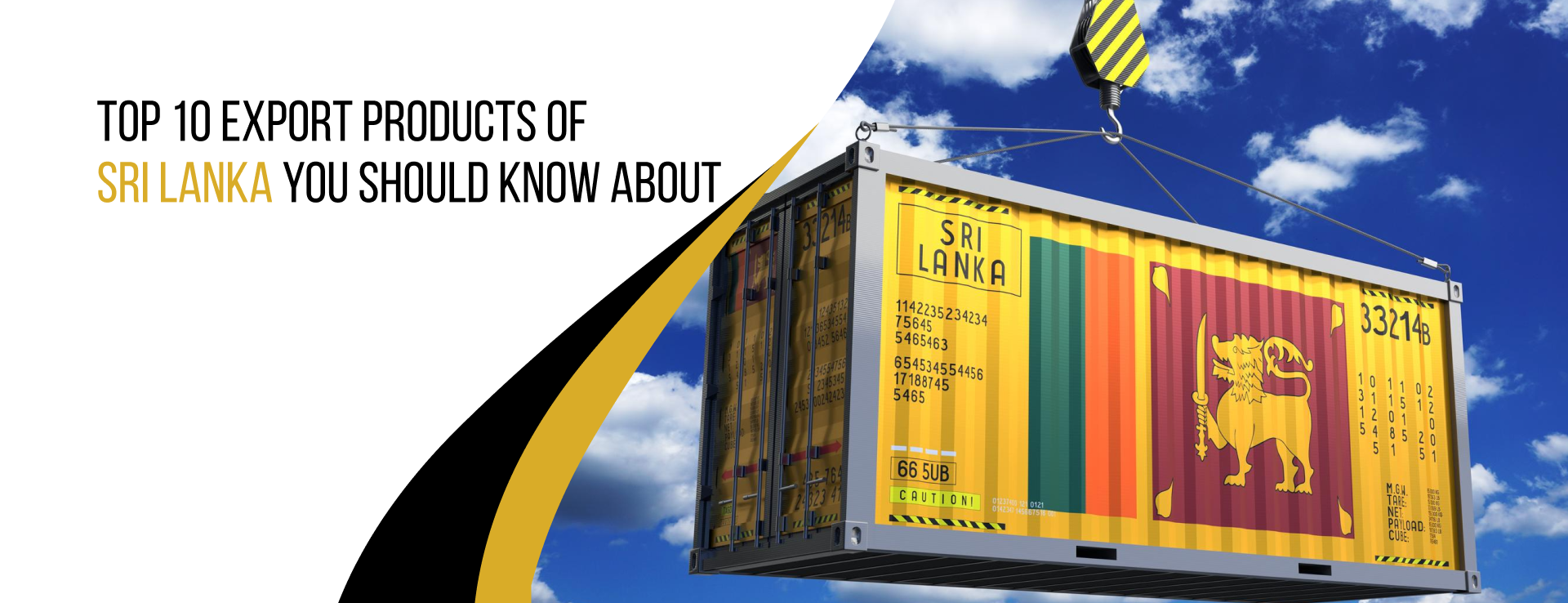

What Are the Top Export Products from Sri Lanka in 2026?
Sri Lanka and its tea have defined its global image for decades. But the story doesn’t stop there because the island’s export basket has steadily expanded which is now reflecting shifts in global demand and domestic capabilities. If you closely look at the top export products from Sri Lanka, you will see a more layered picture.
Tea remains one of the most recognized exports but now it’s expanding into multiple sectors like apparel, rubber, spices, gems and much more. Because of this, Sri Lanka's trading profile becomes quite interesting in 2026. It is a nation that is balancing heritage exports with modern manufacturing while dealing with changing global supply chains, sustainability pressures, and evolving buyer demand. The leading exports of Sri Lanka now indicate how the country is responding to the international markets and how it’s gradually building a more diversified export economy.
Get Access To Sri Lanka Export Data
Overview of Sri Lanka’s Export Economy
Sri Lanka’s export sector has been recovering steadily and the numbers reflect it. The total exports of Sri Lanka in 2025 including both merchandise and services exceeded $17.25 billion. Coconut products, food and beverages, and gems are just some of the highlighted sectors. Though the country was not able to achieve its official export target, the result of reaching 94.79% of the target after a difficult economic crisis indicates that it is a reasonable level.
Manufactured goods and plantation agriculture still dominate Sri Lanka’s major exports. The garment sector is the biggest single contributor to the country's export revenue and a big proportion of the formal labour force is employed in this sector. Still, other industries like tea, coconut spices, rubber and seafood give Sri Lanka an agricultural export identity that similar-sized economies hardly have.
The country’s strategic location along major shipping routes helps maintain consistent trade flows. This advantage supports both raw material exports and value-added manufacturing. The latest export data of Sri Lanka also reveals a slow transformation towards the production of goods with higher value. On top of just increasing volume, the exporters are now giving priority to quality, sustainability, and aligning with global standards. This change is one of the reasons for the expanding list of Sri Lanka’s top export products in 2026.
Top Export Products of Sri Lanka April 2025 - March 2026
The ranking below covers the top 10 export products from Sri Lanka for April 2025 to March 2026, based on export value in USD:
| HS Code | Description | Value in USD |
| 61 | Knitted Apparel & Clothing Accessories | $2.58B |
| 09 | Coffee, Tea, Mate, Spices | $1.92B |
| 62 | Woven Apparel & Clothing Accessories | $1.75B |
| 40 | Rubber, Rubber Products | $1.27B |
| 84 | Machinery, Mechanical Appliances | $756.89M |
| 27 | Minerals Fuels, Petroleum Products | $519.44M |
| 20 | Preparations of Vegetables, Fruits, Nuts | $491.51M |
| 85 | Electricity, Electronics Equipment | $436.46M |
| 71 | Diamonds, Gems, Jewellery | $356.84M |
| 03 | Fish, Frozen Seafood | $196.80M |
Knitted Apparel (HS 61)
Apparel exports in Sri Lanka are dominated by knitwear which includes activewear, t-shirts, swimwear, and knitted casual clothing. Sri Lanka apparel export statistics indicate a steady increase, mainly from EU buyers. Sri Lanka's garment sector has chosen to build its image around quality and compliance, not only price, which gives it an edge in retaining premium brand clients who Bangladesh or Cambodia might not be able to attract.
Coffee, Tea, Mate & Spices (HS 09)
This HS chapter alone captures both tea and spices which are Sri Lanka’s most globally recognized products. Tea brought in over $1.5 billion in full-year 2025. Sri Lanka cinnamon export statistics have been tracking positively, with cinnamon gaining ground in premium food, beverage, and wellness markets in Europe and North America.
Woven Apparel (HS 62)
Trousers, dress shirts, jackets, and formal wear comes under this category of woven apparel.
Together with knitted apparel, these two categories make up the dominant share of merchandise export earnings. The US and UK buyers generate the primary demand, while EU markets grow in parallel. The apparel manufacturers in Sri Lanka have maintained these long- standing buyer relationships by focusing on quality standards, ethical manufacturing practices, and regulated manufacturing practices.
Rubber & Rubber Products (HS 40)
Finished rubber products - gloves, tyres, tubes, and industrial rubber goods make up most of what ships under this category. The sector contracted in 2025 as glove demand softened post-pandemic. Tyre and tube exports partially compensated. Sri Lanka's natural rubber production base remains an underlying cost advantage, but the sector needs new product development to replace the pandemic-era glove volume.
Machinery & Mechanical Appliances (HS 84)
Pumps, valves, industrial components, and specialized equipment. Smaller in volume but representative of Sri Lanka's gradual industrial diversification beyond textiles and agriculture.
Mineral Fuels & Petroleum Products (HS 27)
These are largely re-exported through the Colombo port. Sri Lanka doesn't produce oil domestically - this category reflects the country's role as a regional shipping and transhipment hub in the Indian Ocean, which gives it trade flows that a landlocked economy simply wouldn't have.
Preparations of Vegetables, Fruits & Nuts (HS 20)
Sri Lanka's coconut export statistics have been among the most positive in recent years. Majorly the coconut oil, coconut milk powder, coconut cream, desiccated coconut, and activated carbon from coconut shells. Activated carbon alone is a value-added industrial product with strong global demand. This category represents Sri Lanka's clearest example of shifting from raw commodity exports to processed, higher-margin derivatives.
Electrical & Electronic Equipment (HS 85)
Electronics don't always feature in discussions about the Sri Lanka export products list, but they belong there. Electrical components and subassemblies for global manufacturers - not consumer devices - make up most of this. It's intermediate goods feeding into European and Asian supply chains, and it's been growing consistently.
Diamonds, Gems & Jewellery (HS 71)
Sri Lanka's sapphires, rubies, and alexandrite have global name recognition. The gems and jewellery category is high in value per unit, but volatile - individual large shipments move the monthly numbers significantly.
Fish & Frozen Seafood (HS 03)
The main markets for tuna, shrimp, and frozen fish are the EU, US, and Japan. In fact, the sector experienced successful growth in the year 2025, with frozen fish exports leading the way in the sector's recovery after years of only partial restoration to EU food safety compliance. It hasn't achieved its earlier peaks but is going ahead in a positive direction.
Why Sri Lanka’s Export Industry Continues to Evolve?
There are many reasons why the export industry here is evolving despite significant domestic economic stress. The expertise in apparel manufacturing is the clearest example as the garment sector here spent three decades building skills in technical, compliance-intensive product categories. Sri Lanka tops export products in garments as the buyers achieve better unit prices than regional competitors, plus they have strong belief in the production of complex orders. That positioning took years to build and it's not easily disrupted. Geographical advantage is also another reason why the export industry continues to evolve. It reduces freight costs for buyers, enables fast re-export flows, and supports sectors like petroleum product re-exports that wouldn't otherwise exist.
Next is value-added agricultural exports which is the most visible one. The coconut sector is the suited example - from raw copra exports to coconut oil, activated carbon, and wellness ingredients. Sri Lanka cinnamon is starting to follow a similar path, being pushed into premium and organic market segments rather than bulk commodity channels. Global sourcing diversification by Western buyers has also consistently benefited Sri Lanka on the apparel side. The country's compliance record and environmental certifications attract brands that need responsible sourcing credentials to satisfy their own stakeholder requirements.
Wrapping Up
Sri Lanka's exports are more spread out than they used to be. Garments still lead - but coconut products grew 42% in a single year, gems jumped nearly 46%, and electronics are quietly building a consistent presence. The best export items from Sri Lanka in 2026 don't come from the same two sectors anymore, and honestly, that's the best thing that could be said about the country's trade profile right now.
Tracking these trade flows requires more than just figures. Shipment-level Sri Lanka import export data tells you the specifics - which buyers, which ports, which product variants, and at what volumes. Businesses tracking Sri Lanka's export market rely on trade intel platforms and shipment data tools to identify buyers, suppliers, and emerging product opportunities.
EX-IM by The Dollar Business provides shipment-level Sri Lanka export and import data that supports faster, more confident trade decisions. Book a demo today to see how EX-IM can help you.
Frequently Asked Questions:
1. What is Sri Lanka’s biggest export in 2026?
The biggest export for Sri Lanka in 2026 is knitted apparel (HS 61) at $2.58 billion value of exports.
2. Is tea still one of Sri Lanka’s top exports?
Tea remains a significant export as it brought in over $1.11 billion in 2025 but it's no longer the leading export as knitted apparel & clothing accessories dominate with $2.58B exports.
3. What are the major export items of Sri Lanka?
The major export items of Sri Lanka are apparel, tea, spices, rubber products, coconut products, gems, electronics, seafood, and machinery components.
4. Where can I find detailed Sri Lanka export and import data?
Shipment-level Sri Lanka import export data - including buyer details, HS codes, port-level breakdowns, and volume trends - is available through trade intelligence platforms like EX-IM by The Dollar Business.
Recent Blogs
What Does Sri Lanka Import the Most in 2026?
Discover the top import products of Sri Lanka in 2026 from mineral fuels and machinery to textiles and pharma Click to learn more
What Does Vietnam Import the Most in 2026?
Discover Vietnam's top import products in 2026 from semiconductors to steel Explore HS codes key trade partners and much more
Global Iron Ore Exports Explained: Suppliers, Buyers & Market Shifts
Explore global iron ore exports in 2025 top exporting and importing countries ore grades HS codes India's shifting role and much more