
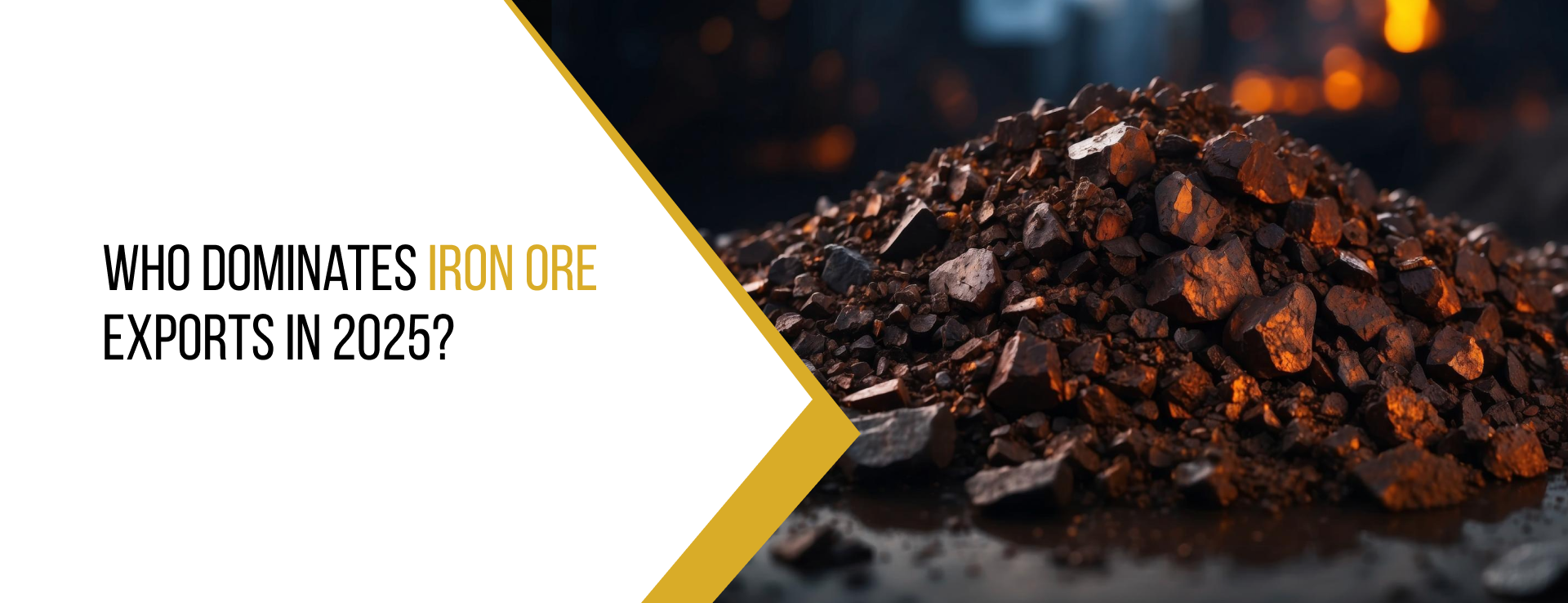

Global Iron Ore Exports Explained: Suppliers, Buyers & Market Shifts
Key Highlights:
-
The HS code 2601 classifies iron ore and concentrates
-
China is the largest importer with $94.02B iron ore imports in 2025
-
Australia supplies a substantial amount of iron ore with an export value of $77.98B which is about 59.15% of the market share in 2025
-
High grade iron ore contains 62% Fe, and above which is sold in premium pricings
-
India keeps most of its iron ore production for domestic consumption, reflecting its domestic-first strategy
Get Access to Iron Ore Trade Data
Iron ore is more than just a commodity today, it's the center of modern infrastructure, manufacturing, and industrial growth. Every large construction project like railway network, bridge, commercial tower, and automobile industry depends on steel in some form, and the steel production begins with iron ore. Without a steady flow of iron ore exports, the global steel industry simply stops.
What makes this market interesting is how interconnected it has become. A slowdown in Chinese construction can affect mining activity in another continent. Freight costs in one region can shift export competitiveness elsewhere. Even environmental regulations now influence which grades buyers prefer. At the same time, the market doesn’t move evenly, some lead in production, others dominate the consumption, while factors like ore quality, logistics, steel demand, and pricing cycles continue to shape global iron exports.
What is Driving Global Ore Demand?
Steel demand is the biggest force behind iron ore imports. As urbanization and infrastructure investment remains the biggest demand driver - roads, ports, energy projects, and urban housing all require steel in large quantities. While countries like China also dominate the force and continue to influence the market more than any other country. It consumes the substantial amount of iron ore in the world, and in 2025, the imports reached $94.02B. Large-scale infrastructure spending and manufacturing activity keep their demand levels high, even during slower economic cycles. At the same time, demand patterns are slowly shifting. A newer trend is the push for green steel. It’s still early, but buyers now prefer higher‑grade ore because it lowers emissions during production. This change in technology is making certain types of iron ore more valuable than ever before.
Major Iron Ore Importing Countries in 2025
| Top Importing Countries (2025) | Value (USD) |
| China | $94.02B |
| Japan | $9.67B |
| Rep. of Korea | $7.20B |
| EU-28 | $7.14B |
| Germany | $3.48B |
| Malaysia | $1.48B |
China remains the dominant buyer, based on the value it accounts for a 65.99% market share of total global iron ore imports in 2025. It's due to its steel mills which run at a scale no other country can match. After China, Japan and South Korea remain major importers with purchase values of $9.67B and $7.20B which contribute highly to their advanced manufacturing industries. EU-28 also holds a substantial presence in the market with an import value of $7.14B in 2025. Germany and Malaysia also continue to import significant volumes with $3.48B and $1.48B respectively to meet domestic industrial requirements. Overall the import value highlights Asia’s major role in global steel production and its continued dependence on imported iron ore to fuel economic activity.
Major Iron Ore Exporting Countries in 2025
| Top Exporting Countries (2025) | Value (USD) |
| Australia | $77.98B |
| Brazil | $28.96B |
| Canada | $6.13B |
| South Africa | $6.13B |
| Ukraine | $2.27B |
| USA | $527.43M |
Several countries dominate iron ore exports due to their large reserves and efficient mining operations. In 2025, Australia leads the list, followed by Brazil, Canada, South Africa, Ukraine, and the USA. Each region has its own strengths. Australia leads by a wide margin, exporting nearly $77.98B worth of iron ore in 2025. With its vast reserves, advanced mining infrastructure, and close proximity to major Asian buyers, particularly China, give it a strong competitive advantage. Brazil follows as the second-largest exporter with an export value of $28.96B, supported by some of the world's highest-grade iron ore deposits. Canada and South Africa each contributed over $6B in exports serving some of the key steel producing markets like North America, Europe, and Asia. Despite the global challenges Ukraine stood as a major supplier to the global market, whereas the United States continues to export smaller but significant volumes. Together all these countries play a major role in supplying the raw materials and supporting global steel production and industrial growth.
Understanding Iron Ore Grades and Why They Matter?
Not all iron ore is the same, the percentage of iron content in the ore has a direct impact on price, logistics, and how the ore is used in steelmaking. Iron ore is broadly classified into three grades: High-grade ore, Medium-grade ore, and Low-grade ore.
| Iron Ore Grade | Iron Content (Fe) | Commercial Characteristics | Market Position |
| High-Grade Ore | 62% Fe & above | Most valuable. Requires less processing, lowers emissions, and supports green steel production | Premium pricing |
| Medium-Grade Ore | 58-62% Fe | Standard benchmark grade used widely in global steelmaking and international contracts | Mainstream bulk trade |
| Low-Grade Ore | Below 58% Fe | Requires beneficiation, sintering, or pelletizing before steel production | Discounted pricing |
| HS Code | Product Type | Description |
| 260111 | Non-agglomerated iron ore & concentrates | Iron ore fines and lumps shipped in raw form |
| 260112 | Agglomerated iron ore & concentrates | Pellets, briquettes, and processed ore products |
| 720110-720390 | Pig iron & direct reduced iron | Semi-processed iron products derived from ore |
| 2601 | Iron ores and concentrates | Main HS category covering global iron ore trade |
One major shift in the market currently is the growing preference of high-grade ore. There is increasing pressure for reduced emissions, particularly in advanced markets. Higher-grade ore assists in lower coal utilization and improves production quality which makes it commercially attractive despite higher upfront prices.
This is also changing global trade flows. Countries which have premium-grade iron ores have stronger pricing power, while lower-grade exporters face growing pressure to enhance processing capabilities.
India occupies an interesting position in this market. The country mainly exports low-to-medium iron ore fines and imports some higher-grade materials required by the advanced steel mills. That gap reflects both India’s mining profile and the increasing demand for cleaner, higher-efficiency steel production domestically.
India’s Role in Iron Ore Trade
India ranks amongst the top producers of iron ore, has been exporting the metal for a long time, and then again, has been importing high-quality ore. The four states - Odisha, Chhattisgarh, Jharkhand, and Karnataka - together contribute over 90% of the total iron ore production in India. But, India is not very visible in international export lists despite a large scale of production, and the biggest reason for this is that a major part of India's mining output is now utilised domestically. The government has pivoted toward a "domestic-first" approach. By applying export duties on certain grades, especially the high-grade product which currently faces a 30% export duty in India, they've ensured that domestic steel plants have enough raw material to build local highways and bridges.
The government is now considering extending export duties to low-grade fines too, which would further compress India's export volumes. At the same time, India's imports of high-grade ore have surged - more than doubling in 2025 - as domestic mills, particularly large players like JSW Steel, turn to Brazil and Oman to fill the gap left by limited high-grade domestic supply. While China remains India's dominant export destination, the broader picture is clear: India is no longer just a raw material supplier. It's becoming a major consumer in its own right, and that shift is tightening global iron ore supply for everyone else.
Iron Ore Pricing Trends: What Actually Moves Prices?
Iron ore prices don’t follow a simple pattern. They react to steel production levels, weather disruptions at mining sites, freight costs, and even currency swings. Policy changes in China often influence global sentiment within hours.
Grades also impact pricing. High‑grade ore trades at a premium because it improves efficiency and reduces emissions. When steel margins tighten, mills switch to lower‑grade blends, which adjusts global iron ore exports and demand levels.
Future Outlook
The next five years will be defined by three simultaneous pressures: supply growth, demand uncertainty, and a push toward greener steelmaking. The long‑term success still leans toward steady demand. Urban development, infrastructure renewal, and clean‑energy expansion support steel usage. Over time, high‑grade ore could become even more valuable as green steel technologies scale up. New exporters may emerge, but established iron ore suppliers are likely to hold their ground. Buyers will continue balancing cost, grade, and logistics in a market that rewards flexibility.
The green transition is creating a long-term structural shift in what kind of ore gets valued. High-grade ores at 65%+ are essential for hydrogen-based steelmaking, and steel accounts for about 7-8% of global carbon emissions, putting iron ore exporters under pressure to support greener production methods. Countries locked into lower-grade supply may need to invest in beneficiation (ore upgrading) to stay competitive.
How to Identify Active Iron Ore Buyers and Suppliers?
If you are a trader, miner, or an exporter, understanding who is actively buying and selling iron ore, at what volumes, from which countries, is more useful than any macro trend overview. When you look at actual import-export shipment data, you start seeing the markets in real time trade flow statistics. With trade intel you can track which suppliers are gaining market share in a specific destination country. You can benchmark your own pricing against what competitors are actually charging.
That's exactly what EX-IM By The Dollar Business provides. EX-IM gives traders, exporters, and importers access to verified import-export shipment data across iron ore and hundreds of other commodity categories. Whether you're an Indian exporter looking for active buyers in Southeast Asia, a European steel mill assessing new iron ore suppliers, or a commodities trader tracking supply flows into required ports, EX-IM's data gets you to the right markets faster, which you can't get from cold outreach alone.
Frequently Asked Questions:
1. Which country imports the most iron ore?
China, by a large margin. It accounts for roughly 60-70% of all global iron ore imports by value, driven by the world's largest steel industry.
2. Which countries export the most iron ore?
Australia leads with $77.98B exports in 2025, followed by Brazil, Canada, South Africa, Ukraine, and the USA. These regions have strong mining bases and established shipping routes.
3. Why is iron ore important globally?
Iron ore is the primary raw material for steel, and steel is foundational to almost every major industry like construction, automotive, shipbuilding, energy infrastructure, and manufacturing making it important globally.
4. Why are iron ore prices volatile?
There are certain factors responsible for its volatile pricing. The biggest reason is the Chinese steel demand. Others are mining output, freight costs, geopolitical issues, and supply disruptions.
5. What are high-grade iron ores?
High-grade iron ore contains 62% iron content or above, with premium grades running at 65% Fe and higher.
Recent Blogs
The Hidden Cost of HS Code Errors in International Trade
Learn the most common HS code mistakes exporters make and how they lead to customs delays higher duties penalties and lost profits
What Does Sri Lanka Import the Most in 2026?
Discover the top import products of Sri Lanka in 2026 from mineral fuels and machinery to textiles and pharma Click to learn more
What Does Vietnam Import the Most in 2026?
Discover Vietnam's top import products in 2026 from semiconductors to steel Explore HS codes key trade partners and much more