
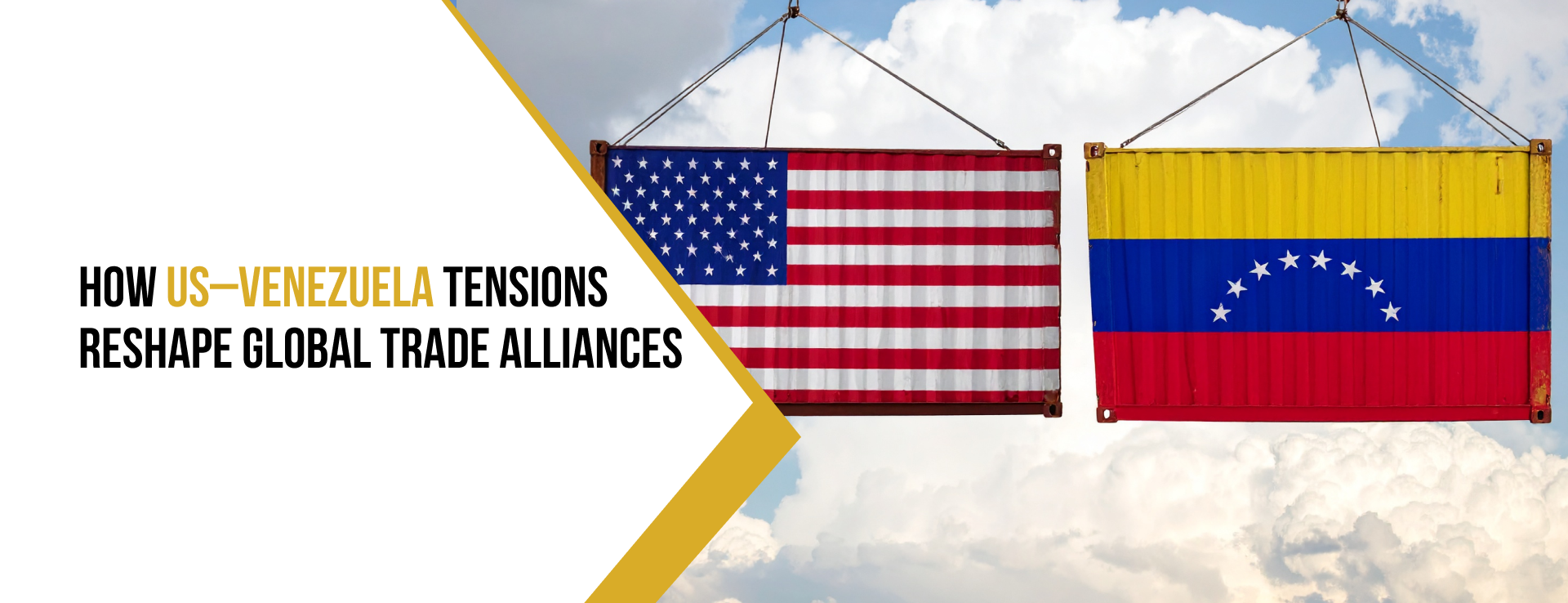

How US–Venezuela Tensions Reshape Global Trade Alliances
The world awoke to a shock by the geopolitical crisis on January 3, 2026, when a bold move taken by military operation launched by the US resulted in President Nicolas Maduro and his wife being seized and flown to America to stand trial. This imprints one of the most direct military interventions seen from America within Latin America within recent decades and brings ideas of “a US-Venezuela war” facade of global political discourse.The encouragement behind US intervention includes claims of illegal activity and illegitimate voting.
Its effects have serious effects not only in diplomatic circles but also in the trade relationships of the world and our stance on investments. Already, the world is burdened by broken supply chains and geopolitical tensions, and the increasing hostility between the United States and Venezuela is the best example of how a political conflict can spill over into international trade.
Why Does The US Earmark Venezuela?
The geopolitical landscape is a crucial factor, even as US officials point to supposed criminal activity and election fraud as justifications for their actions. Venezuela, after all, is a key player in the global energy market, sitting on some of the planet's most substantial proven oil reserves.
The United States, viewing the Venezuelan government as both antagonistic and corrupt, has long pushed for a change in leadership there, using diplomatic pressure and economic sanctions as its primary tools.
The latest military intervention is seen by the United States as a precise act, which targeted the arrest of a leader accused of committing an international crime. At the same time, some scholars of international law believe that if a leader is removed from a sovereign country by armed intervention, this goes beyond international law.
They believe that either narco-terrorism or election fraud was simply a reason to achieve another goal of a geopolitical nature, including control of oil resources.
Sanctions In Venezuela And Their Trade Impact
Long before the current military tensions, Venezuela sanctions had already been grappling with multiple rounds of U.S. These measures targeted the country's oil, finance, and energy industries, aiming to squeeze Caracas into altering its political course. The goal was to diminish state control over vital exports, especially crude oil, and consequently, reduce the nation's revenue. The impact was significant: Venezuela's economy and international trade suffered greatly. Many former trading partners, fearing secondary sanctions, scaled back or halted their economic activities.
Sanctions in Venezuela have already thrown a wrench into trade, stifled foreign investment, and forced trading partners to get creative, often using middlemen or alternative markets to get around the rules. Now, these problems are compounded by the uncertainty surrounding the president's abduction, raising fresh worries about the country's long-term economic health and its political independence.
India–Venezuela Trade: Limited Exposure But Strategic Considerations
Despite this global backdrop, the volume of trade between India and Venezuela has remained very small compared to overall India Venezuela trade. In terms of overall Indian trade risk, the PFC’s exposure to Venezuela’s oil and goods was relatively minimal in FY25. This was because the total import of Indian oil from Venezuela was around $1.8 billion from overall trade worth $1.16 trillion, while the exports from India to Venezuela were valued at $217 million, which comprised just 0.05% and 0.23% of total exports and imports, respectively.
Despite this low level of economic engagement, this event also brings to the forefront how the geopolitical instabilities in a prominent oil-producing country may affect the calculations for the larger community of countries on issues related to energy security. The country's oil policy has actually focused on diversified oil sourcing; yet, in the event of a disturbance in oil supplies, especially within a country that has proven oil reserves, it may impinge upon market sentiment.
Precious Metals: Safe-Haven Reaction to Geopolitical Risk
Financial markets have been significantly impacted by the US-Venezuela war narrative and rising geopolitical risk. The price of gold and silver skyrocketed in early January 2026 as investors looked for security against uncertainty. Due to widespread demand for safe havens, silver prices nearly reached 14% on January 6 while gold prices increased by about 4%.
On commodity exchanges, spot gold approached $4,500 per ounce, and silver neared $82.2 per ounce - both near their historic highs supported by geopolitical anxieties, weaker real yields, and continued concerns over supply disruptions. In India, too, the futures prices mirrored the rally as gold futures touched historic highs while silver neared ₹2.5 lakh per kilogram.
The rally, in part, can be linked to the concerns expressed by financial experts regarding the future implications for the Venezuelan government as an oil exporter, as concerns escalate in the Latin American market and market unpredictability related to the effect such sanctions, shocks, and new alliances have created. The safe haven factor for bullion stock continues to be aided by the central and institutional demand with market predictions indicating an upward trend for precious metals for the years ahead in 2026.
Frequently Asked Questions (FAQs)
1. How do US–Venezuela tensions reshape global trade alliances?
U.S.-Venezuela tensions are forcing countries to rethink energy sources, trade alliances, and financial systems. Increasing sanctions accelerate shifts toward alternative suppliers and non-dollar exporters and importers.
2. How can businesses track trade risks arising from US–Venezuela tensions?
Access to accurate, recent trade data helps them understand risks, track policy changes, and follow disrupted supply chains so they can be confident in their choices.
3. What is the impact of sanctions in Venezuela on international trade?
Sanctions have also limited Venezuela’s oil exports, banking, and foreign investments. This has made supply chains disconnected, and as such, traders have no choice but to use third-party sources.
4. How exposed is India–Venezuela trade to this geopolitical crisis?
This provides them access to correct and up-to-date trade statistics, which helps them comprehend risks and monitor policy and supply chains so that they can feel assured about their decisions.
5. Why is verified trade data critical during geopolitical crises?
Crises in geopolitics tend to create confusion and uncertainty in policy shifts. Using accurate trade statistics, importers, exporters, and investors can base decisions on facts rather than estimates.
6. Why do precious metals react strongly to US–Venezuela tensions?
In the middle of geopolitical occurrences like the US-Venezuela tension, investors look for the safe havens that gold and silver provide.
7. How can exporters identify new opportunities amid disrupted energy and commodity markets?
By Trade intelligence tools assist in the selection of active customers, monitoring imports per country, and moving ahead towards a stable market.
Recent Blogs
Sea Freight vs Air Freight: How To Choose Right
Confused between sea freight and air freight? Discover the real factors that drive the decision and find out what suits your business best
Russian Oil Exports by Country: Who Buys the Most?
Discover Russian oil exports by country who depends most and key trends driving global crude trade