
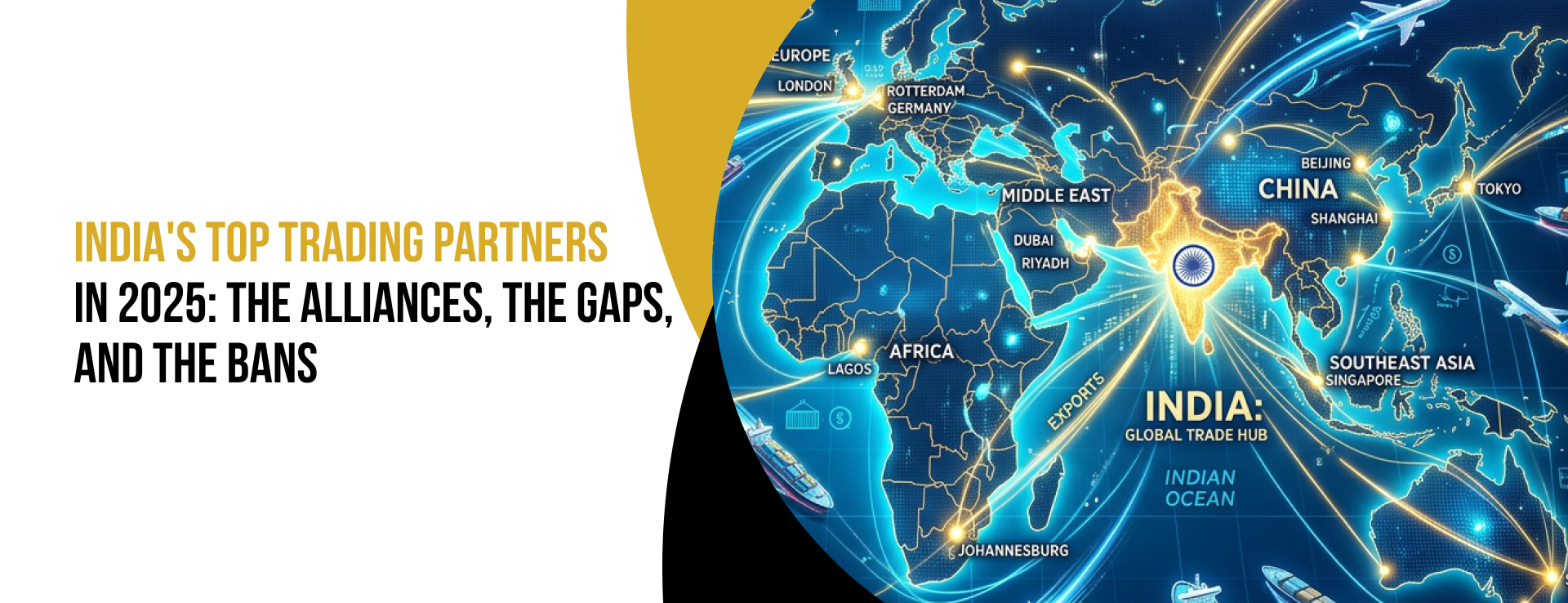

India’s Top Trading Partners in 2025 | Country-wise Analysis
Key Highlights
-
In 2025, the USA stands as India's largest trading partner with bilateral trade value of $131.84 billion
-
Russian crude oil now accounts for over 35-40% of India's total crude imports
-
UAE remains India's third-largest partner and acts as a re-export gateway, not just a buyer
-
In FY25, India’s reliance on China for Active Pharmaceutical Ingredients (APIs) reached approximately 74%
-
India's total merchandise + services trade surpassed $1.7 trillion in FY25, with exports reaching a record $824.9 billion
India’s Top Trading Partners 2025
India’s trade story in 2025 isn’t just about numbers, it's about a country adjusting its position in a world that changed faster than anyone expected. The trade story during 2025 isn’t just about moving goods from one place to another. It’s a complex game of alliances, supply chain security, and strategic de-risking.
With total trade (exports and imports combined) crossing the $1.7 trillion mark in FY25, the country is no longer just a participant in global markets, it’s emerging as a major driver. That's not a small number for a country which is still classified as a lower-middle-income economy by some metrics.
These shifts didn’t happen in isolation. Post-pandemic supply chain diversification, a strained Russia-West relationship, rising protectionism in the West, and India's own push for manufacturing self-reliance, all of it is showing up in how India buys and sells with the world. These relationships aren’t random. They’re built on cost, scale, demand, and long-standing trade ties. Some countries supply what India needs to run its economy. Others buy what India produces at scale.
India’s Trade Landscape
India trades with most of the world, but most trade value comes from a small group of countries. In FY25, exports were around $437 billion while imports were closer to $721 billion. That concentration is not accidental. It reflects supply chain depth, energy needs, and long-term commercial ties. But this concentration isn’t uniform, it follows a clear pattern.
India’s trade landscape is broadly divided into two distinct relationships. One is export-led relationships like the one with the USA, where we send out more value than we take in. On the other, there are import-driven dependencies, most notably with China and the UAE, where we source the raw energy and electronics that fuel our domestic growth.
Understanding India’s top trading partners means understanding which role each country plays.
China: The Import Partner India Can’t Easily Replace
China continues to dominate as India’s biggest import source. This isn’t new, and it hasn’t changed despite policy efforts. Despite geopolitical tensions, the total import volume remains sky-high with $113.4 billion in FY25. This is because China owns the "scale" advantage that few can match. Plus, costs are competitive and supply chains are deeply integrated. India’s manufacturing sector still depends on these inputs. Even when alternatives exist, they’re not always as efficient or cost-effective.
However, this has created a "strategic dependency." India is currently working on diversifying these with the help of PLI (Production Linked Incentive) schemes. However, China remains the major supplier. A closer breakdown in top products India imports from China shows how critical these imports are to industries like electronics, pharma, and engineering.
USA: India’s High Value Export Market
The US remains India’s largest export destination in 2025 and continues to import a diverse range of Indian goods. For FY25, exports surged past $86.51 billion. The US market values quality and compliance. Indian exporters who meet these standards gain access to high-margin opportunities. This is where India’s strength shows. It’s not competing on cost alone. It’s competing on capability. If you break it down further, the top 10 products fueling exports to USA highlights how diversified and value-driven this relationship is. Out of those categories, pharmaceuticals alone account for a significant chunk, India supplies roughly 45% of generic medicines consumed in the US.
Also Read: Top 10 Products India Imports from the USA
However, India and the USA trade heavily with each other, the relationship isn’t always smooth. Section 232 tariffs on steel and aluminium, and ongoing disputes at the World Trade Organization, create periodic tension. But the overall trade size and diversity of export categories suggest this is a resilient partnership, not a fragile one.
UAE: Trade Hub & Strategic Gateway
The UAE plays a dual role in India’s trade ecosystem. It’s not just a trading partner, it’s a trade hub. In FY25, the UAE became India’s second largest export destination with an export value of $36.64 Billion. India exports petroleum products, gems and jewellery, engineering goods, textiles, and food products to the UAE. In the other direction, the top products India imports from the UAE are dominated by crude oil and petroleum products, gold and precious metals, diamonds, and minerals. The UAE also serves as a re-export hub, as it routes products from other countries to India, acting as a global trade hub.
Russia: Trade Shaped by Energy
Before February 2022, Russia wasn't a top five trading partner. Trade relations with Russia have become popular over the last two years and today it's among India's top three sources of imports. For FY25, imports from Russia surged to $63.84 billion. While it was once dominated by defence, it is now a critical energy and commodity partnership. This relationship has grown due to global shifts. Pricing advantages and supply availability have made Russia a key partner. On the export side, the top 10 products India exports to Russia show how India is slowly expanding its presence beyond just traditional goods.
United Kingdom: Stable & Mature Market
The UK is a constant export market for India in 2025. This relationship stands out not only for its consistency but also for its resilience over time. At present, some of the top 10 products India exports to the UK include pharmaceuticals, clothing and apparel, chemicals, and refined petroleum products. India also generates huge revenues from IT and outsourcing services, but these are not considered part of physical goods. With a Free Trade Agreement (FTA) which is almost completed, these product lines are likely to experience a major reduction in tariffs, thereby increasing the competition of Indian products in London and other areas.
Turkey: Niche but Growing Trade Link
Turkey may not be a top trading partner, but it still plays a unique and important role in the niche category. Known globally for its strong steel exports, the country supplies materials that assist India’s construction and manufacturing sectors. The top products Turkey exports to India include machinery and mechanical equipment, iron and steel, mineral products, organic chemicals, and textiles. Whereas India exports pharma goods, refined petroleum, organic chemicals, and cotton. In FY25, total bilateral trade between the two countries stood at around $8.71 billion.
Turkey provides alternatives in categories where India prefers not to rely entirely on East Asia. Volumes may be smaller, but flexibility matters in uncertain times. This is a smaller relationship, but it fills specific gaps in supply.
Bangladesh: The Neighbour That Buys More Than Anyone Think
Bangladesh isn’t discussed as often as countries like China or the USA, but it probably should. Bilateral trade touched $13.51 billion in FY25, with India's exports at $11.46 billion against imports of just $2.05 billion - one of India's largest trade surpluses with any single country. Cotton yarn, petroleum products, fresh vegetables, and spices make up the bulk of what India sends, much of it moving through land routes that keep delivery fast.
What India imports from Bangladesh is small in value but still meaningful for Indian retail - readymade garments, footwear, and jute goods lead the list of Indian imports from Bangladesh. See the Top Products India Imports from Bangladesh. What’s worth noting is that this relation kept growing even after political conflicts in Dhaka since 2024.
Vietnam: The ASEAN Partner Balancing the Books
India and Vietnam share a more evenly matched trade relationship on the list. Total trade hit $15.76 billion in FY25, though India actually ran a deficit here - exports of $5.43 billion against imports of $10.33 billion. Frozen meat, fishery products, machinery, auto components, and pharmaceuticals head one way, and what comes back to India from Vietnam include electronics, phones, and manufactured components. This is a reflection of just how fast Vietnam's factories have scaled up in the last decade. Check here the detailed list of Top Products India Imports from Vietnam. Vietnam's rise as a manufacturing base means it's becoming both a bigger buyer of Indian meat and pharma, and a growing competitor to Indian factories elsewhere.
Australia: A Trade Deal Doing Its Job
The India-Australia Economic Cooperation and Trade Agreement, signed in 2022, has visibly reshaped this relationship. Bilateral trade reached $24.1 billion in FY25, and on the import side, coal, minerals, and pulses dominate what flows from Australia into India - see the full list of products in top products India exports to Australia. From January 2026, all Indian exports become eligible for zero-duty access into Australia, which should push this relationship further in India's favor over time.
Canada: A Relationship Rebuilding Itself
Canada-India trade faced challenges following the diplomatic tensions of 2023, but the commercial relationship never actually stopped. Bilateral trade stood at $8.66 billion in FY25, split almost evenly, with pulses, potash, coal, and fertilizer leading what India brings in from Canada - covered in detail in top products India imports from Canada. With diplomatic ties restored through 2025 and CEPA talks underway aiming for $50 billion in trade by 2030, this looks like a relationship getting back on track rather than one in permanent decline.
Singapore: Where Trade and Finance Meet
Singapore isn’t just a buyer of Indian goods, it also plays a key role in India's overall trade and investment network. Bilateral trade reached $34.3 billion in FY25, with India exporting $13.0 billion - largely mineral fuels, gems, jewelry, and machinery, all covered in top 10 products India exports to Singapore. It also happens to be the single largest source of foreign direct investment into India. For exporters, Singapore works less like a typical customer market and more like a gateway.
Afghanistan: Trade That Keeps Moving Despite the Odds
India’s export to Afghanistan isn’t very large compared to other trading partners, but they reached around $318.9 million in FY25. To get the detailed list, see the top 5 products India exports to Afghanistan which is often led by pharmaceuticals, vehicles, and apparel. The story here isn’t really about size, it's about persistence. With Pakistan denying transit, most of this trade now moves through Iran's Chabahar Port, and India recently overtook Pakistan as Afghanistan's largest single export destination. It's a relationship that survives politics because both sides still need what the other has.
Brazil: A Growing South American Bridge
Though Brazil doesn’t really show up in most conversations about India’s top trading partners, the numbers have started earning a spot. Bilateral trade reached $12.20 billion in FY25, with India importing $5.43 billion - raw sugar, crude oil, soybean oil, and cotton lead this side, detailed in top products India imports from Brazil. Both India and MERCOSUR are planning to expand their current trade agreement and have set a target of $20 billion in bilateral trade by 2030. For exporters seeking to expand Latin America, Brazil is arguably the most accessible entry point right now.
Iran: A Smaller Relationship Shaped by Sanctions
India and Iran used to share a strong trade relationship, with bilateral trade reaching closest to $17 billion in FY19, mainly due to crude oil. Later, the imposed sanctions changed that almost completely. In FY25, exports to Iran stood at $1.24 billion in which more than half of it includes basmati rice alone, alongside tea, sugar, and pharmaceuticals, all covered in top products India exports to Iran. Today, trade between India and Iran is largely centered around food products and pharmaceuticals, with Chabahar Port serving as a key gateway. The port also supports India's trade with Afghanistan by providing an alternative route that bypasses Pakistan's transit restrictions.
A Closer Look to What Actually Moves Trade
When you look at the main things, the top products Turkey exports to India, the products driving India's exports to Russia, India relies on China for a significant share of its API supply, aggregate data can hide important underlying trends. Most of India's import exposure is in industrial inputs, not finished consumer goods. Most of India's export strength is in sectors with genuine global competition: generic pharma, IT services, refined petroleum, gems and jewellery.
This means replacing imports isn’t as easy as it sounds, you’re not swapping out luxury goods, but essential industrial inputs. And when it comes to exports, growth will come either from scaling what India already does well or building new strengths in areas like electronics and semiconductors.
Wrapping Up
India’s trade relationships in 2025 reflect a mix of dependency and opportunity. China remains critical for imports. The US continues to drive high-value exports. The UAE acts as a gateway. Russia is shaping energy trade. Smaller partners fill specific gaps.
These patterns aren’t random. They’re built on economics, scale, and long-term trade behaviour. For businesses, the takeaway is simple. The more clearly you understand who India trades with and what flows between them, the easier it becomes to spot opportunities early. Because in global trade, advantage rarely comes from reacting. It comes from seeing patterns before they become obvious.
If you’re looking to track these patterns more closely, trade tools such as EX-IM By The Dollar Business provide shipment-level data and real-time trade insights with the right HSN codes, which can make a real difference. Book a quick demo with us to get more clarity on how these insights can be turned into actual opportunities!
Frequently Asked Questions
Who is India’s largest trading partner in 2025?
The USA is India’s largest trading partner in 2025.
What does India export the most to the United States?
India mainly exports pharmaceuticals, engineering goods, textiles, and IT-related services to the US. These are high-value categories where quality and compliance matter more than just cost.
Why is the UAE an important trade partner for India?
UAE is not just a trade partner for India but also a global re-export trade hub. It handles large volumes of gold, petroleum, and re-exports, making it a strategic gateway for Indian trade.
Why is trade with Pakistan completely banned right now?
The main focus of the ban by the Indian government is national security and public policy issues. Through cutting direct and indirect imports, India is signaling that regional stability is a non-negotiable requirement that cannot be compromised for economic partnership.
How can businesses use trade data to find opportunities?
Using right trade data assists businesses to find which market is right, who is buying, what is being traded and in what volumes. These are few of the crucial details that traders must know if they want to be successful in their import-export journey.
Recent Blogs

Best Products to Export Based on Global Demand 2026
Discover best products to export in 2026 based on global demand and market opportunities Identify highdemand products and top export markets

India’s Import Export Data: Everything You Need to Know in 2026
Trade data isn't just numbers Discover how Indian businesses use importexport data to find buyers track competitors and much more in 2026
CIF vs FOB vs EXW Explained for Beginners
CIF vs FOB vs EXW explained for beginners learn what each Incoterm means who pays for what and when risk transfers in international shipping