
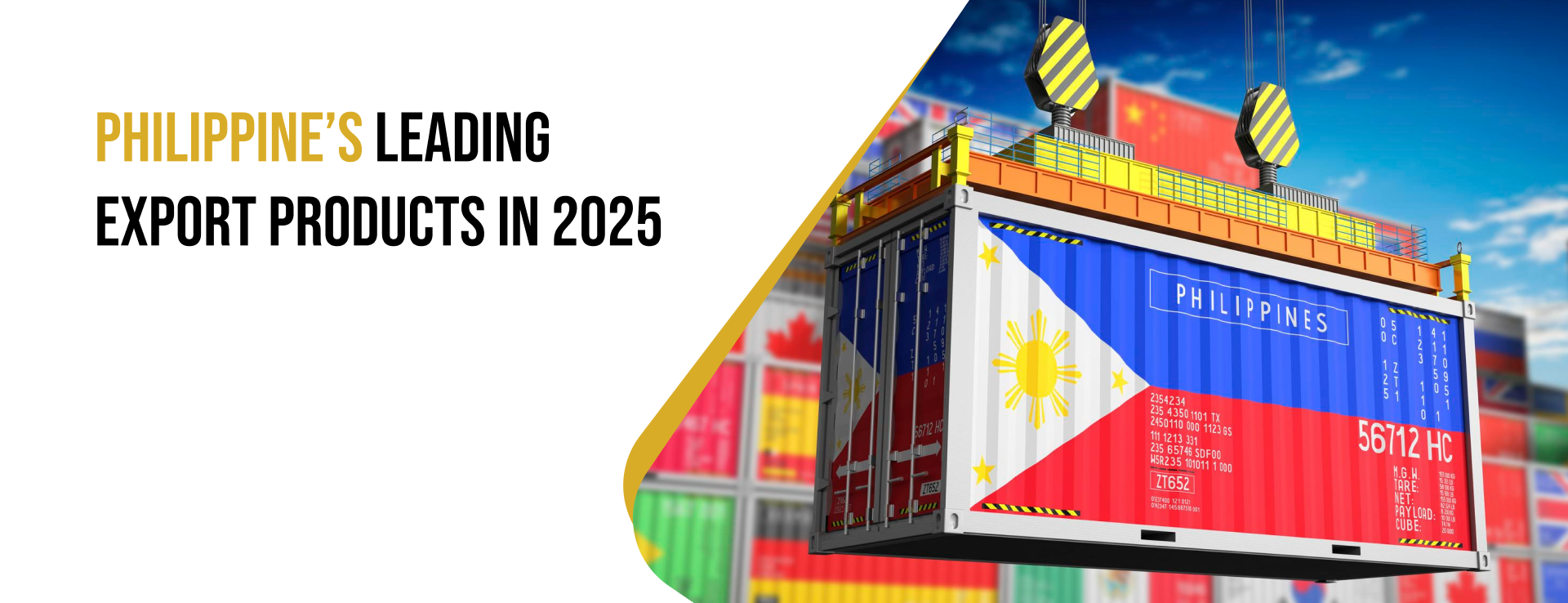

Top Export Products of Philippines in 2025
Key Highlights
-
The total Philippines exports in 2025 reached $82.88B
-
Electronics is the single largest export with a value $40.29B
-
United States is the top buyer of Philippine goods at $18.22B
-
Philippines exports to 10+ major markets across 4 continents showing well-distributed trade footprint rather than dependence on a single region
Get Access To Philippines Trade Data
In global trade, the Philippines has quietly emerged as one of Asia’s most important export-driven economies. Today, it’s not just about the agricultural staples like bananas or pineapples as when someone talks about Philippines exports in 2025, it's even more complex and impressive. The country’s export profile has undergone a significant shift, moving beyond traditional farm-to-table goods to become a vital hub in the high-tech global supply chain. You’ll find that the industries that drove growth in 2025 are not random, they reflect a strategic, deliberate push into advanced manufacturing and specialized technology. A closer look at the top exports of Philippines in 2025 tells which industries are driving growth in 2026, where international demand is strongest, and much more.
Total Exports is $82.88B in 2025
Exports are one of the most important pillars of the Philippines economy and in 2025 the total export value was $82.88B. This export performance of the Philippines in 2025 reflects the country’s growing role in international trade. This was possible due to the strong export momentum for electronics, machinery, agricultural products, and mineral resources despite the fluctuations. Agricultural exports, especially edible fruits and nuts, continued to perform well and the jewellery and precious metals category - often overlooked in broader trade conversations - has carved out a surprisingly solid position among the country's top exports. These things won’t just reflect one sector doing well but about several sectors holding their ground at the same time.
Top 10 Export Products of the Philippines 2025
The table below shows you the top 10 export products of the Philippines in 2025 by HSN code and export value. It highlights the backbone of the country’s trade activity, showcasing the categories that brought in the most value during the CY 2025.
| HS Code | Description | Value (USD) |
| 85 | Electrical machinery and equipment | $40.29B |
| 84 | Machinery and mechanical appliances | $6.51B |
| 90 | Optical, photographic, medical, measuring | $3.13B |
| 15 | Animal, vegetable, or microbial fats and oils | $2.85B |
| 08 | Edible fruits and nuts | $2.61B |
| 26 | Ores, slag, and ash | $2.57B |
| 71 | Pearls, precious stones, precious metals, and jewelry |
$2.53B |
| 74 | Copper and articles thereof | $1.68B |
| 39 | Plastics and articles thereof |
$1.05B |
| 27 | Mineral fuels, mineral oils, and products of their distillation |
$773.62M |
Electrical Machinery and Equipment (HS 85)
Products under HS 85 get exported the most from the Philippines. With an export value of $40.29B in 2025, products like semiconductors, integrated circuits, and electronic components are being exported worldwide. This is not just the first category that leads by a wide margin but also the first by a margin that accounts for everything else combined. This category also contributes in shaping employment, foreign investment, and industrial policy across the country.
Machinery and Mechanical Appliances (HS 84)
Industrial machinery, engines, and mechanical components with an export value of $6.51B comes in second place. These products often support broader manufacturing operations both domestically and for export assembly elsewhere. It reflects how Philippines export products are tied to production and infrastructure.
Optical, Photographic, Medical, Measuring (HS 90)
Import value of $3.13B in 2025 under HSN 90 reflects the country's growing role in precision manufacturing. These products require tighter quality control and more specialised labour than basic assembly work, which says something about the direction the manufacturing base is heading.
Animal, Vegetable, or Microbial Fats and Oils (HS 15)
With an export value of $2.85B in 2025, the products under HSN 15 are largely driven by coconut oil and related products. The Philippines has long been one of the world's major coconut producers, and this category reflects that legacy - it's one of the more traditional entries on this list carrying a substantial export value.
Edible Fruits and Nuts (HS 08)
The products under the HSN 08 supplied around $2.61B worth of exports which were mostly dominated by bananas and pineapples. The Philippines have exported these two crops at scale for decades. This category is a good reminder that agriculture hasn't disappeared from the export mix - it's just smaller relative to electronics than it used to be.
Ores, Slag, and Ash (HS 26)
With an export value of $2.57B, raw mineral exports like nickel ore have become increasingly important to the Philippine’s export economy, driven by growing global demand from the battery and stainless-steel industries. Its place among the top exports of the Philippines is one of the categories worth watching closely over the next few years.
Pearls, Precious Stones, Precious Metals, and Jewelry (HS 71)
The products under HSN 71 which include pearls, precious stones, precious metals, and jewellery, hit an export value of $2.53B in 2025. The Philippines has a well-established jewellery manufacturing industry, much of it built around gold and other precious metal processing for export markets.
Copper and Articles thereof (HS 74)
Copper plays a major role in construction, electronics, energy projects, and industrial manufacturing and the Philippines continues to support exports in this category. With an export value of $1.68B reflects its strong mining sector. Copper concentrates and refined copper products make their way into global supply chains, particularly toward electronics and construction industries.
Plastics and Articles thereof (HS 39)
The products under HS 39 include both finished plastic goods and components used in broader manufacturing such as packaging materials, industrial components, containers, and various manufactured goods. They’re tied closely to the electronics and packaging sectors which support both consumer and industrial supply chains worldwide which justifies the $1.05B exports in 2025.
Mineral Fuels, Mineral Oils, and Products of their Distillation (HS 27)
Although smaller than other categories on this list, fuel-related exports remain a valuable part of the country's trade portfolio. However, it's important to note that the Philippines isn't a major oil producer, refined products and related distillates still account for meaningful export value. The total export value of products under HS 27 reached $773.62M.
Which Countries Import the Most Goods from the Philippines?
The table below shows the top destination markets for Philippines export products in 2025, based on total import value from each country.
| Country | Value (USD) |
| USA | $18.22B |
| China | $13.98B |
| EU-28 | $10.73B |
| Japan | $10.39B |
| Germany | $5.14B |
| Mexico | $3.73B |
| Republic of Korea | $3.50B |
| United Kingdom | $2.60B |
| Netherlands | $2.39B |
| Malaysia | $2.14B |
It’s interesting to see that the United States continues to be the largest buyer of Filipino goods, reflecting strong bilateral ties and a high demand for Philippine electronics. China and the broader European market also feature prominently, demonstrating the Philippine’s ability to navigate diverse trade environments. The strong presence of markets like Japan, Malaysia, and Korea highlights how deeply ingrained Philippine supply chains are within the larger Asian manufacturing ecosystem. Mexico's position likely ties into electronics assembly operations feeding North American supply chains, while the Netherlands often serves as a European distribution and logistics hub. Germany and the United Kingdom’s industrial and electronics demand also drives most of the import value.
How Trade Data Helps Businesses Identify Export Opportunities?
If you’re in global trade, looking at these data is useful, but real value comes from understanding things on much deeper levels. Actual shipment records, buyer and supplier names, ports of origin, and trends over time all play a crucial role in a successful trade journey. Getting these data is easy but accurate and reliable is not. That’s why trade intel tools come into the play. Trade platforms provide you with accurate data to help identify which markets are growing for a specific product category, and which buyers are actively importing similar goods right now. For importers, it works the other way - you can see which Philippine suppliers are shipping a particular product, at what volumes, and to which markets.
If you're an importer looking for export statistics Philippines then platforms like EX-IM by The Dollar Business can give you access to shipment-level trade intelligence that helps you make informed decisions. You get real supplier details, buyer activity, and trend data across HS codes and markets, which means you're working from actual trade patterns rather than general assumptions.
Book a demo to see how EX-IM can help you find buyers, suppliers, and your next big trade opportunity!
Frequently Asked Questions
1. Who are the top export partners of the Philippines?
The top five export partners of the Philippines are the USA, China, EU - 28, Japan, and Germany - they are the major buyers of Philippines electronics, machinery, and manufactured products.
2. What are the top export products of Philippines?
Some of the top export products of the Philippines include electronic items, semiconductors, computers, electrical machinery, insulated wires, cables, coconut oil, processed food products, medical devices.
3. Where can I get Philippines export data?
For a successful trade you must operate with reliable data and you can get accurate Philippines export data from trade intel platforms like EX-IM By The Dollar Business.
Recent Blogs
India’s Import Export Data: Everything You Need to Know in 2026
Trade data isn't just numbers Discover how Indian businesses use importexport data to find buyers track competitors and much more in 2026
CIF vs FOB vs EXW Explained for Beginners
CIF vs FOB vs EXW explained for beginners learn what each Incoterm means who pays for what and when risk transfers in international shipping
Trade Myths vs Reality: What Every Exporter Should Know
Trade myths vs reality: discover the truth about export profits pricing market expansion and how import export data can guide your export strategy