
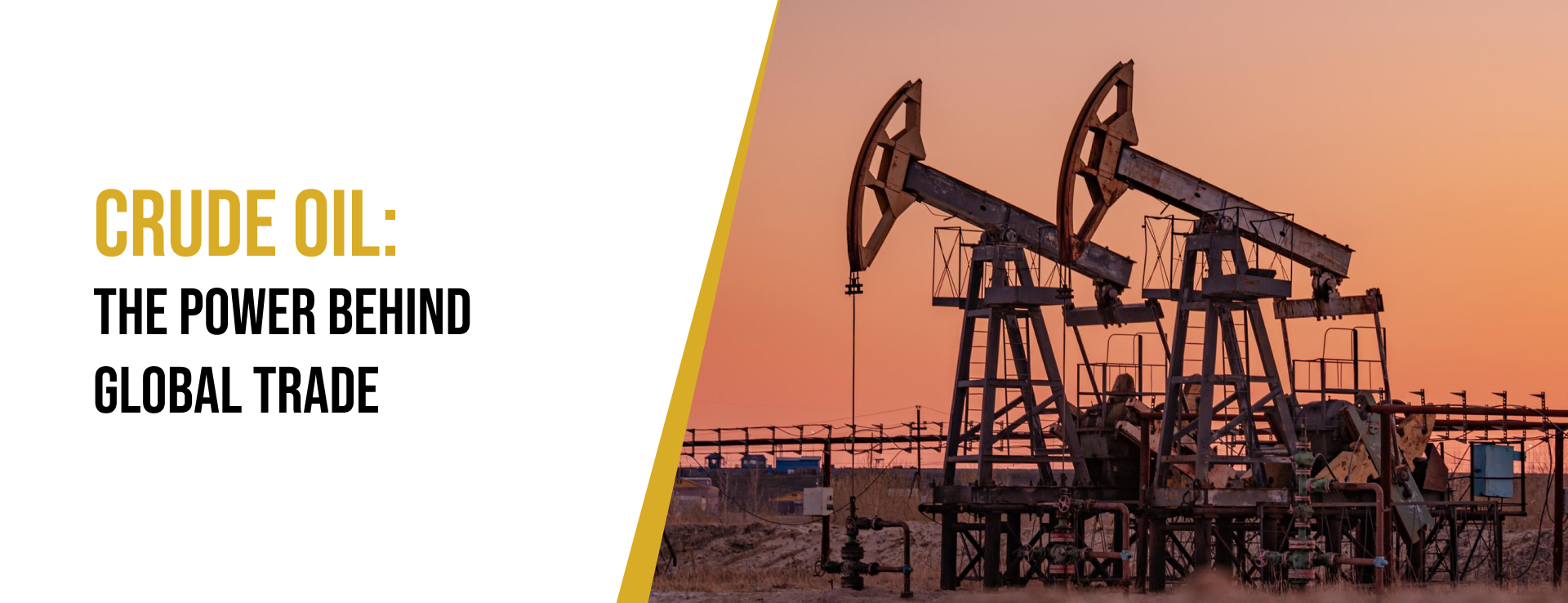

Crude Oil Trade, Strait of Hormuz & Top Importing Countries
Key Highlights:
-
Through the Strait of Hormuz, nearly 20% of global oil is transported, making it a vital trade route.
-
The data provided in the blog is dated from August 2025 to February 2026.
-
The HSN code of crude oil is 2709.
-
In terms of dollars, the total value of the mentioned 10 countries lies at nearly $78.9 billion.
Crude oil is a factor that determines where global power shifts, and control over it sets a country's GDP and economic growth, making it one of the most trending topics in international trade and energy discussions. Amid rising geopolitical tensions in the Middle East, especially around the Strait of Hormuz, one of the world’s most sensitive oil transport routes, has become a consequential concern about potential disturbance in global oil supply. Nearly one-fifth of the global petroleum passes through this narrow maritime corridor, meaning any dissension, blockade, or instability can straight away trigger spikes in crude oil prices and shake the international market. For energy-dependent economies like India, which imports nearly 90% of its crude oil requirements, importing from this route, the ongoing disturbance amid the Iran-US conflict is going to impact fuel prices, trade balances, and inflation.
Why Is Crude Oil Considered The Backbone Of Any Country?
Crude oil is not only a raw material that gives several by-products such as petrol, diesel, kerosene, and so on. But it's something more essential than this, from countries' transportation and manufacturing to agriculture and power generation, almost all major industries rely on petroleum-based energy and products. A stable crude oil supply ensures smoother industrial operations and controlled cost distribution, supporting the production of plastics, chemicals, and fertilizers. Crude oil is deeply woven into the economic structure of modern nations, making its supply and pricing a vital key in global economic stability.
A Look At The World’s Largest Crude Oil Importing Countries:
|
Countries |
Value (USD) |
|
INDIA |
$61,414,924,043.58 |
|
INDONESIA |
$4,638,360,752.09 |
|
VIETNAM |
$2,647,346,572.21 |
|
PAKISTAN |
$2,097,079,174.49 |
|
NIGERIA |
$1,568,263,619.70 |
|
PHILIPPINES |
$1,553,715,832.24 |
|
CHILE |
$1,466,066,774.70 |
|
PERU |
$1,400,152,412.08 |
|
BANGLADESH |
$1,160,814,502.63 |
|
MALAYSIA |
$958,445,791.67 |
Get Access To Crude Oil Trade Data
India holds the position of the largest crude oil importer among these countries. India imports crude oil valued at $61.4 billion. This is followed by Indonesia, which imports crude oil valued at $4.63 billion. Vietnam and Pakistan import crude oil valued at $2.64 billion and $2.09 billion, respectively. Other countries that import crude oil include Nigeria, the Philippines, Chile, Peru, Bangladesh, and Malaysia. These countries import crude oil valued between $958 million and $1.56 billion.
The data provided by EXIM clearly highlights that India is the biggest importer of crude oil among these, showing its high energy consumption and strong dependence on imported oil to support transportation, industry, and economic growth.
The Growing Importance Of Trade Intelligence In A Geopolitically Unstable World:
In an ongoing geopolitical uncertain situation, global trade patterns can change abruptly due to the contrast of ideas, sanctions, and supply disruptions. In such an environment, trade intel like EXIM by The Dollar Business has become more essential for traders to acknowledge market demand, analyse import-export trends, and spot new opportunities. By trusting real-time trade data instead of assumptions, businesses can make measured decisions, reduce risks, and adapt briskly to the changing and challenging global market.
Frequently Asked Questions (FAQs)
1. How much percent of the Strait of Hormuz is controlled by Iran?
There is no exact percentage to be officially assigned to Iran, but it's roughly half of the Strait of Hormuz's surrounding territory (north side).
2. Which country is most dependent on crude oil imports?
India nearly import 80%-90% of its crude oil demand in terms of dollar value, $61,414,924,043.58, highly dependent on international oil trade and the Strait of Hormuz.
3. Why are smart Trade Intel's like EXIM now more essential than before?
Smart trade intel gives real-time data, updated shipments, trend analysis, and many more features, which make trading less risky and enable making decisions based on authentic data and calculated moves.
4. How much oil is being transported through the Strait of Hormuz in a day?
Nearly 14.9 to 20 billion MBDP (thousand barrels per day) was transported through the Strait of Hormuz in a day.
5. What happens if the Strait of Hormuz is blocked entirely?
The blockage may cause a disruption in a significant share of the world’s oil supply, which may result in a rise in the price of oil globally, supply shortages, a rise in the price of transportation, and a corresponding rise in the inflation rates of the importing countries.
Recent Blogs
What Are the Top Export Products from Vietnam in 2026?
Discover Vietnam's top export products in 2026 by HS code value and market Also understand what's driving Vietnam's $475B export economy
What Are the Top Export Products from Sri Lanka in 2026?
Discover the top export products from Sri Lanka in 2026 from apparel and tea to coconut goods rubber gems and much more

Top Red Flags to Spot Fake Export-Import Buyers Online
How to identify fake exportimport buyers online with practical red flags a verification checklist & payment term strategies that protect your shipments