
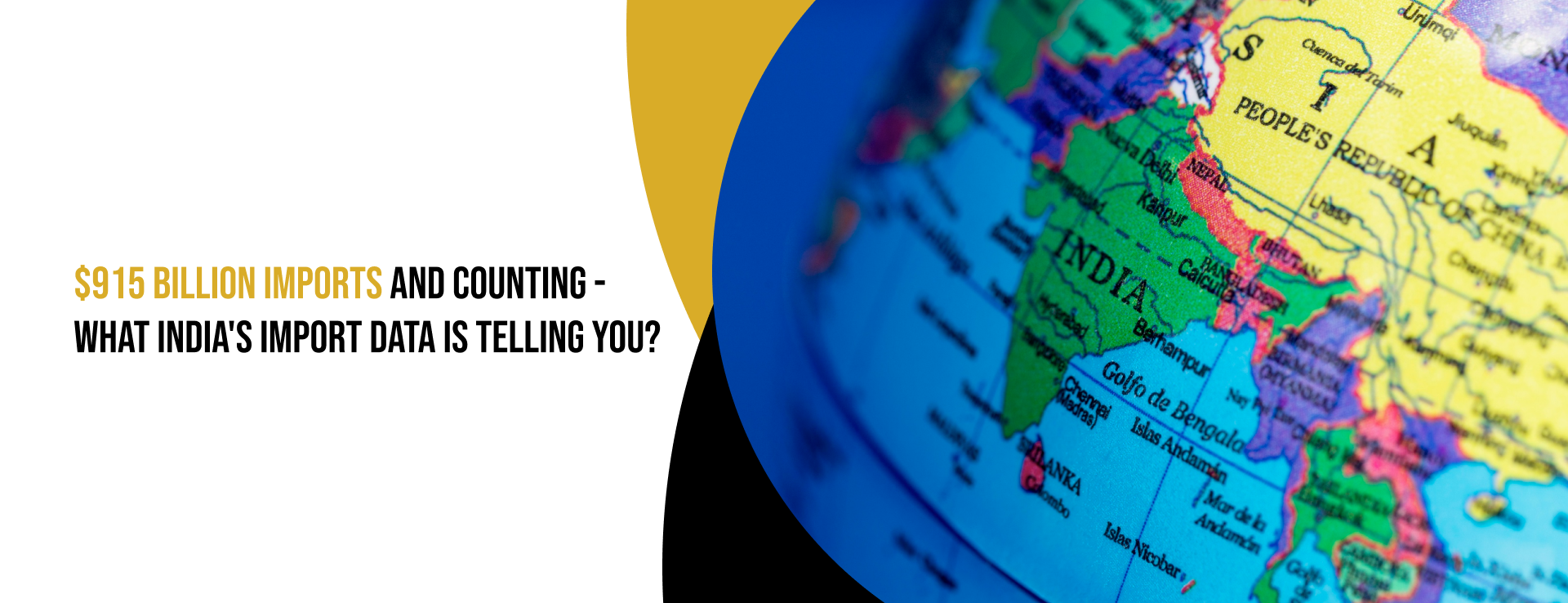

India's Import Trends 2025: Top Products and Partners
Key Highlights:
-
India imported goods worth US$915.19 billion in 2024-25
-
India imports more high-value items than volume
-
India imports nearly 85% of its crude oil
-
Energy, consumer demand, industrial inputs, and supply chain gaps drive most of India’s imports today
-
China leads in exporting goods to India in high volumes, while the US supplies high-value, precision goods
-
Indian middle-class buyers are shifting toward electronics, premium foods, and lifestyle products.
India imported goods worth over $915.19 billion in 2024-25. But looking at the total figure alone doesn’t define the point. The real point is in what India is importing, from which countries, and why those choices are being made. Some imports are non-negotiable, like energy, API's (Active Pharmaceutical Ingredient), and speciality steel that domestic production simply can't cover. Others reflect a fast-growing middle class buying things it couldn't afford a decade ago. Some are geopolitically loaded. And a few are seasonal, they spike predictably and then drop. Understanding import trends isn’t about tracking numbers alone. It’s about reading demand, identifying supply gaps, and knowing where opportunities exist.
What's Actually Driving India's Imports?
Before getting into the product specifications, let’s understand what are the driving forces for India’s import market landscape. The country’s import bill continues to grow, driven by four major factors.
Energy Needs
This tops the list as India imports roughly 85% of its crude oil, with energy demand continuing to outpace domestic supply. Despite significant investments in solar and renewable energy, the country's industrial base and transportation networks run largely on petroleum. This makes energy one of the most stable and high-value import categories.
Consumer Demand
This is the second driving force in the Indian import segment, and it is increasing fastly. This is not because Indian consumers are buying more but because they’re buying differently. The buyers are increasing their purchases for electronics, lifestyle goods, and processed foods. This is growing at such a pace that domestic manufacturing hasn’t matched yet.
Industrial Growth
The manufacturing sector needs imported components, chemicals, raw materials, and high-grade metals, particularly for automotive, electronics, and infrastructure industries. In India, these inputs aren’t produced in required quality or can’t be scaled quickly. This makes the global supply chain essential here.
Supply Chain Gaps
India produces a lot, but not everything. In some categories, the production either doesn’t exist at scale or doesn’t meet the required quality for buyers. Steel, gold, and certain chemicals are good examples. Imports are not a weakness, they’re signals of demand and the Indian domestic market is large enough to use both local production and imported goods parallelly.
Who India Depends on and why?
Some imports are not optional, they’re genuinely essential. Certain products, along with the countries supplying them dominate India’s import landscape. When you look at the top 10 products fueling India’s import business, you see that categories like crude oil, electronics, gold, machinery, and chemicals are a necessity at present. If these slow down, it directly affects the factories and supply chains. It happens because they are tied directly to energy, consumption, and industrial needs. This is exactly why the countries supplying these critical imports hold such strategic importance, let’s take a closer look at who they are.
China: Scale That’s Hard to Replace
Despite political tensions and years of policy effort to reduce dependency, China remains India's largest import source by a wide margin. The top 10 import goods from China include electronics, machinery, organic chemicals, plastics, fertilizers, and active pharmaceutical ingredients. In several of these categories, China isn't just competitive, it's dominant. The reason isn’t only lower cost. It’s the ability to deliver scale quickly and consistently that no other country has fully replicated. Even with active policies, replacing China is difficult as it's a slow process. In the short term, it remains important.
The United States: Known for High-Value not High-Volume
The US-India imports relationship looks entirely different. India doesn't import bulk industrial goods from the USA but imports high-value sophisticated goods. Top products India imports from the USA include aircraft and aerospace components, defence equipment, medical devices, industrial machinery, and speciality chemicals which are high-value, low-volume goods. These are known for their quality, compliance, and reliability. The USA isn't India's everyday supplier. It supplies equipment that India either can't make domestically at the required standard or chooses to source from the US due to long-term trade relationships.
Region Specific Trade Relationships
Bangladesh
Not all trade decisions come down to price, location and politics matter too. And India's trade relationship with Bangladesh is often underestimated. India’s imports from Bangladesh are tightly linked to geography and industry linkage. Top products India imports from Bangladesh include cotton yarn, ready-made garments, jute products, and certain chemicals. The shared borders between the two countries make logistics very easy. Over time, strong trade ties between the two countries have helped build well-established supply chains. An interesting point here is that Bangladesh sends finished textile goods to India and, at the same time, brings in raw cotton from India. It is a two-way supply chain relationship and not just a buyer-seller one.
Afghanistan
When it comes to India’s import ecosystem, Afghanistan plays a small but highly concentrated demand in specific categories. Unlike large volume trade partners, Afghanistan’s role is focused and product specific. Imports from Afghanistan majorly highlight agricultural and natural products that India doesn’t produce in the same quantity or due to climatic conditions. The top 5 products India imports from Afghanistan, such as dry fruits, medicinal herbs, raisins, and certain minerals, highlight how focused this corridor is. Despite political instability in the region, supply chains between the two countries have remained surprisingly resilient due to long-standing commercial ties and product-specific demand.
Going Deeper — Commodity by Commodity
Steel Imports
India is the world’s second largest steel producer but still imports steel when domestic supply cannot meet specific requirements. Certain grades and specifications like high-standard alloy steels, speciality flat products, and stainless steel with very tight tolerances are not produced domestically in sufficient volumes. They also often fail to meet the quality requirements of specific industrial buyers. The top 10 destinations for Indian Steel Imports are dominated by China, South Korea, Japan, and a few European suppliers. Steel imports also act as a buffer during demand spikes. When demand spikes, imports fill the gap faster than domestic capacity can.
Gold Imports
India is one of the largest gold-consuming nations in the world, and a huge portion of that gold is imported. This is because it won’t follow industrial logic, but social behaviour. Weddings, festivals, and savings patterns are the major factors for driving demand more than factory production. The top 5 importers of gold in India operate in a market that is primarily led by cultural demand, investment habits, and seasonal buying cycles. The peak times for demand are during festivals and the marriage season. Besides that, price volatility and changes in import duties are also factors that influence buying decisions.
Consumer Demand Imports
Chocolate
The most interesting long-term trend in India’s import data isn’t energy or metals, it's what ordinary consumers are buying. Chocolates are a very good example of how rising incomes are shifting the import patterns. The top 10 chocolate importers in India reflect a consumer base that's trading up from domestic sweets to imported Belgian, Swiss, and premium European brands. It’s a lifestyle import and volumes have been growing steadily.
Toys
Toys also tell a similar story. They're seeing a growing demand as families spend more on children’s products. India's toy import trends show that despite active government policies to boost domestic toy manufacturing, including tariff increases on imported toys, the demand for foreign-branded toys remains elevated. Parents in urban areas still prefer buying dolls from Barbie over local alternatives. Global brands keep selling well because families trust their quality and safety records.
Dates
Dates show how seasonal demand shapes import patterns. It shows a different kind of consumer import as it’s seasonal, culture-specific, and highly predictable. This is because dates import spikes during the Ramadan season and remain elevated throughout the festival period. The top 10 countries driving India's dates import trade are mostly Gulf nations: UAE, Saudi Arabia, Iran, and Iraq. Supply chains for dates can be planned months in advance because the demand curve is consistent every year.
What These Import Trends Actually Tell You?
Most people just look at the import data and see costs. But smart traders look at the same data and understand the signals.
Imports Shows Gaps, Not Weakness
If a product is consistently imported it means the demand exists. If India imports $15 billion worth of electronics components yearly, which is not merely a statistic, but it is an indicator of the areas where the local manufacturing sector is still emerging. For someone thinking about setting up production or sourcing partnerships, that gap is an opportunity.
Seasonal Import Spikes are Underrated Opportunities
Dates during Ramadan and chocolates before Diwali see significant import spikes. Similarly, specific fruits and agricultural products also notice a spike ahead of harvest gaps. These trends follow repeat patterns every year. An importer who plans a checklist around these cycles has an advantage over one who reacts to demand after it's already peaked.
Policy Changes Can Move Markets Overnight
The Pakistan ban is the most obvious example, but it's not the only one. Tariff changes on toys, old import restrictions, changes to API (Active Pharmaceutical Ingredient) sourcing rules for pharma, these policy moves create sudden demand for alternative suppliers.
High-Value Imports Mean Less Competition
The aerospace components, medical devices, and speciality machinery that India imports from the US don't have dozens of suppliers competing to fill every order. The market is thinner, the relationships matter more, and the margins are typically better.
Import and Re-Export is an Underused Strategy
India imports rough diamonds, processes them, and re-exports polished stones at significantly higher value. The same thing applies to other categories like chemicals, agricultural products, and specific metals. The import data shows you the raw input, but the real opportunity is adding value to the product before it’s re-exported.
Wrapping Up
India’s import ecosystem in 2025 is more layered than the numbers suggest. Even with rapid changes, energy will continue to dominate the import basket in the coming years. But the fastest-growing story lies in consumer goods and industrial inputs for manufacturing. It’s also visible in high-value imports that reflect India’s ambitions in sectors like aerospace, pharma, and electronics.
The traders and businesses that do well in this segment aren't the ones with the most capital, they're the ones who read the patterns early. They spot the seasonal spikes before they peak. They identify the policy shifts before the market reacts. They find the supply gaps before competitors do.
That kind of edge comes from reliable data. Real shipment-level data and actual trade flows showing who's buying, who's supplying, and at what volume and frequency. Trade tools such as EX-IM by The Dollar Business is built for exactly this. It provides real-time data on import trends, buyers, and suppliers helping you identify opportunities ahead of your competitors. If it aligns with what you’re looking for, a quick demo can give you a clearer picture.
Frequently Asked Questions:
1. What are the main products India imports the most?
These mainly include crude oil, electronics machinery, gold, and chemicals, which cater to the energy, consumer, and industry requirements of the country.
2. Why does India import so much from China?
China supplies electronics, machinery, and chemicals at a scale India still can’t match. Even with diversification efforts, China remains the fastest and most reliable source for many inputs.
3. Which countries supply high-value goods to India?
The USA leads here. India buys aerospace parts, medical devices, precision machinery, and specialty chemicals from American suppliers because of their quality and technical standards.
4. Why does India import steel despite being a major producer?
Certain steel grades and speciality products aren’t made domestically in the needed quality or volumes. Imports help fill these gaps and support sectors like autos, construction, and infrastructure.
5. Which consumer goods are seeing rising imports in India?
Chocolates, toys, processed foods, and seasonal products like dates are growing fast. Rising incomes and changing lifestyles are reshaping what Indian households buy.
6. Is India's dependency on China for imports decreasing?
India is genuinely trying to rely less on China, and the effort is real. There are active policies pushing domestic alternatives in electronics, pharma, and chemicals. But in 2025, the truth is that for most businesses, China is still the most practical and cost-efficient source for many industrial inputs.
7. What's the smartest way to use India's import data as a trader?
Import data isn't just a record, it's a signal. Consistent patterns show you where demand is steady. Sudden shifts point to supply disruptions or policy changes. Seasonal spikes tell you where to be before demand peaks. The traders who read these signals early are the ones who stay ahead.
Recent Blogs

Top Red Flags to Spot Fake Export-Import Buyers Online
How to identify fake exportimport buyers online with practical red flags a verification checklist & payment term strategies that protect your shipments
The Countries Dominating Rice Exports in 2026
Top rice exporting countries in 2026 ranked by export volume Learn about major exporters key destinations and trade trends
Indian Tea vs Coffee Exports: How the Two Industries Compete in Global Trade
Explore how Indian tea and coffee exports compete globally from buyer markets to valueadded trade structures and much more