
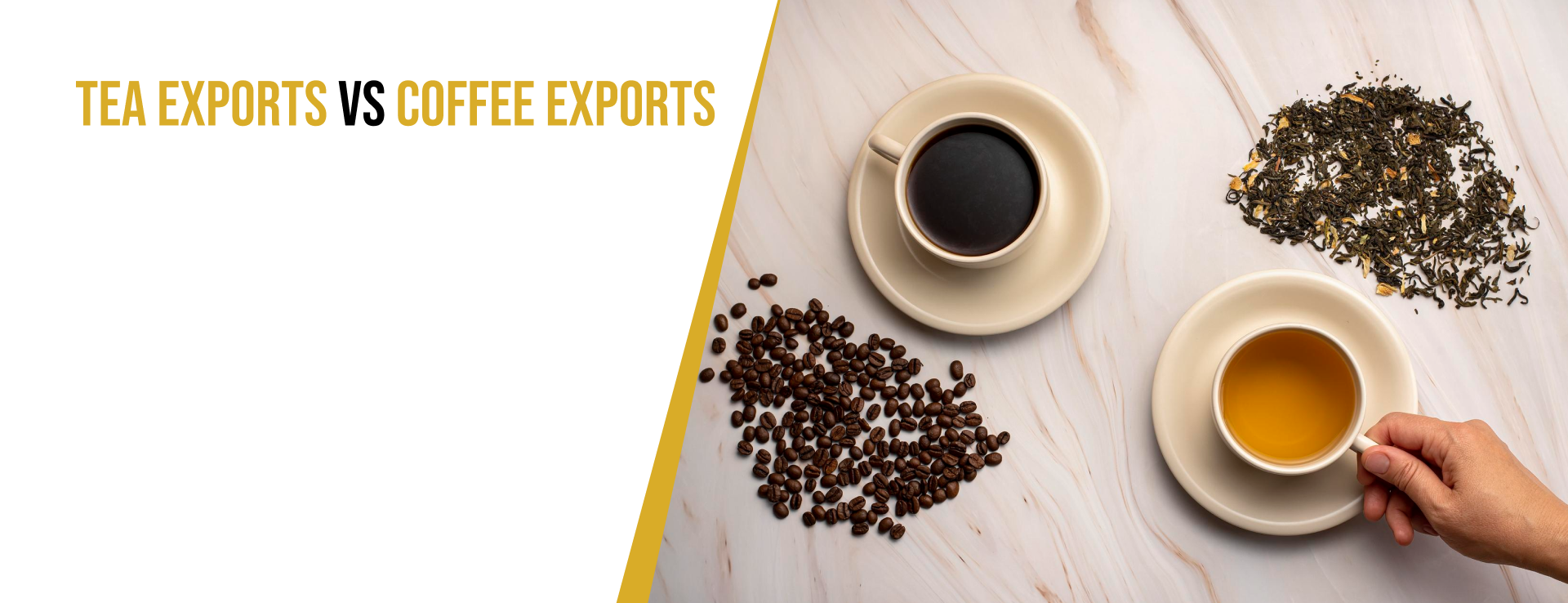

Indian Tea vs Coffee Exports: How the Two Industries Compete in Global Trade
India is simultaneously a top five global exporter of tea and a fast-rising exporter of coffee. Both are significant agricultural export resources. Both are grown in the same southern and north-eastern regions. Yet in terms of how they're traded, who buys them, and what growth looks like going forward, they're quite different industries operating under different competitive conditions.
In FY2024, India's coffee exports crossed ₹106 billion in value, while tea exports stood at ₹68 billion which means coffee now earns more foreign exchange for India than tea does, even though India exports considerably more tea by volume. That gap tells something important about how value is created in each trade.
Tea vs Coffee at a Glance
| Factor | Indian Tea (HS 0902) | Indian Coffee (HS 0901 & 2101) |
|
Primary export nature |
Bulk and auction-driven |
Premium and specialty-driven |
|
Main Production Regions |
Assam, Darjeeling, Nilgiris |
Karnataka, Kerala, Tamil Nadu |
|
Domestic Consumption |
Very high |
Growing steadily |
|
Pricing Structure |
Volume sensitive |
Brand and quality sensitive |
|
Key Buyer Focus |
Traditional beverage market |
Speciality cafes, roasters, premium retail |
|
Value Addition |
Moderate |
Increasingly important |
|
Domestic consumption share |
80% consumed domestically |
30% consumed domestically |
|
Primary varieties exported |
Black tea (96% of exports) |
Robusta beans (dominant), Arabica, Instant |
The differences clearly show that there’s a huge gap between tea and coffee. The differences exist because each of them is consumed distinctly across international markets. Across many countries, tea remains a routine household purchase rather than a seasonal or luxury product. While coffee consumption has become lifestyle-oriented over time, particularly in urban regions.
The domestic consumption pattern explains part of the supply dynamic too. India produces around 1,400 million kg of tea annually, but 80% of it stays inside the country. Only about 18% of production reaches export markets. Coffee has a much lower domestic retention rate, which means proportionally more production flows outward into global trade.
Where Does Indian Tea and Coffee Go?
Tea Export Markets
Tea and coffee exports may come from the same country, but their buyer networks look entirely different. When it comes to Indian tea, it travels to a wide set of destinations. They are concentrated in the Middle East, Central Asia, and parts of Europe. The major three markets for Indian tea exports for March 2025 are Iraq ($14,998,150.71), the UAE ($13,030,253.60) and Russia ($6,795,318.96). The important thing about India's tea markets is that they're largely price-sensitive. Iraq, Iran, and Russia aren't premium markets. They buy on volume and price, which is why Indian black tea - competitively priced but not strongly branded, moves well there. The 2030 target of reaching 300 million kg in tea exports depends heavily on expanding these existing relationships and finding new volume markets.
Coffee Export Markets
The coffee trade looks much more modern and the buyer profile also looks different. The major destinations for coffee exporters are Italy, Germany, and the United States. Italy alone absorbs 18% of Indian coffee exports, followed by Germany at 11%. These are the world's most sophisticated coffee processing hubs. Italian and German roasters import Indian Robusta primarily for espresso blends, where Robusta's body and lower acidity are commercially desirable. The Russian Federation also features as a consistent buyer. Europe's taste preference for Robusta blends aligns well with what India grows, Karnataka alone accounts for 71% of India's total coffee production, producing mostly Robusta. This geographic alignment of supply and buyer preference is part of why Indian coffee has found a stable European market. Value-added products - instant coffee, roasted coffee, preparations account for nearly 38% of total coffee exports and are growing.
Export Market Structure
This is the segment where the difference between these two industries becomes clearer.
Tea exports are largely volume-driven. Black tea holds the most weightage in tea exports from India as it accounts for 96% of the exports and most of it ships as bulk commodity tea. They’re sold at auction and blended at the destination market. Darjeeling, Assam, and Nilgiri are recognised internationally, but branded Indian tea at the retail level in foreign markets remains limited. The Tea Board has been pushing geographic indication (GI) branding and premium positioning for years, but the bulk trade model is deeply rooted. Traders and brokers still dominate the export chain. And the most value addition like the blending, the packaging, and the branding, happens outside India.
Coffee trade has built stronger value-added positioning. Over the past decade, instant coffee exports have grown steadily. India has become one of the world’s highlighted hubs for instant coffee production, and value-added products now account for 38% of total exports. Indian companies like CCL Products have built global manufacturing scale in instant coffee, which supplies branded products to international buyers. Today, coffee generates higher export earnings per kilogram than tea and allows India to make more value from processed coffee products.
Key Players and Industry Structure
The structure of both industries also differs significantly. The tea industry is dominated by large plantation companies, auction houses, and commodity traders. Export is handled by a mix of large business giants. For a closer look at the major players for March 2025 check the top 10 tea export companies in India. The auction system helps move large volumes efficiently, but it also tends to treat tea as a bulk commodity rather than a differentiated product. This often limits direct relationships between producers and international buyers. Small tea growers, who produce around 35% of India's tea under the "bought leaf" system, have minimal direct export access.
The coffee industry also has a more varied export structure. Large commodity traders such as OLAM Agro India, Louis Dreyfus India, and NKG Coffee dominate the green bean exports. But there’s also second tier processing companies like CCL Products and Vayhan Coffee that have invested in soluble and roasted coffee manufacturing. This allows direct supply of value-added products to international food companies. A smaller, emerging third tier of specialty exporters and direct-trade roasters sells micro-lot coffees to European and North American specialty roasters. This layered structure gives Indian coffee exports more price diversity than tea currently has.
The Bigger Trade Picture
Indian tea and coffee exports don’t compete in the same way. Though they belong to the same beverage category, they operate through separate systems. They serve different buyers, operate through different trade structures, and face different competitive environments globally. Tea exports remain more volume-driven and rooted in traditional consumption patterns, while coffee exports highly benefit from specialty demands.
India has a strong hold on both industries, but the competitive pressure works very differently across the two. The future direction of both industries will ultimately depend on how well the exporters respond to changing consumer behaviour, sustainability demands, climate risk, and changes to the nature of global trade. As the world beverage market evolves, tea and coffee export competition is no longer about 'production' but also about who creates the most value across international supply chains.
Frequently Asked Questions:
1. Which country is no.1 in tea exports?
China is the top global exporter and producer of tea. This is due to its huge production capabilities, large overseas demands and a broad spectrum of products from unprocessed 'green teas' to expensive more exclusive blends.
2. Which countries import coffee from India?
Indian coffee is mainly exported to countries like Italy, Germany, Belgium, Russia, and the United States.
3. Which state grows 60% of India's tea?
Assam is the leading tea producing state in India accounting for over 50% of the country's total output. Being a humid locality with heavy rainfall and loose, fertilized, or alluvial soils, the state has conducive conditions for extensive black tea plantations.
4. Why is Darjeeling tea so expensive?
There's a limited supply of Darjeeling tea. It is cultivated in strict climatic conditions in the Himalayan foothills at high altitude, using traditional hand-plucking methods. As it is geographically protected and has unique taste, demand for Darjeeling tea is high.
Recent Blogs
What Does Sri Lanka Import the Most in 2026?
Discover the top import products of Sri Lanka in 2026 from mineral fuels and machinery to textiles and pharma Click to learn more
What Does Vietnam Import the Most in 2026?
Discover Vietnam's top import products in 2026 from semiconductors to steel Explore HS codes key trade partners and much more
Global Iron Ore Exports Explained: Suppliers, Buyers & Market Shifts
Explore global iron ore exports in 2025 top exporting and importing countries ore grades HS codes India's shifting role and much more