
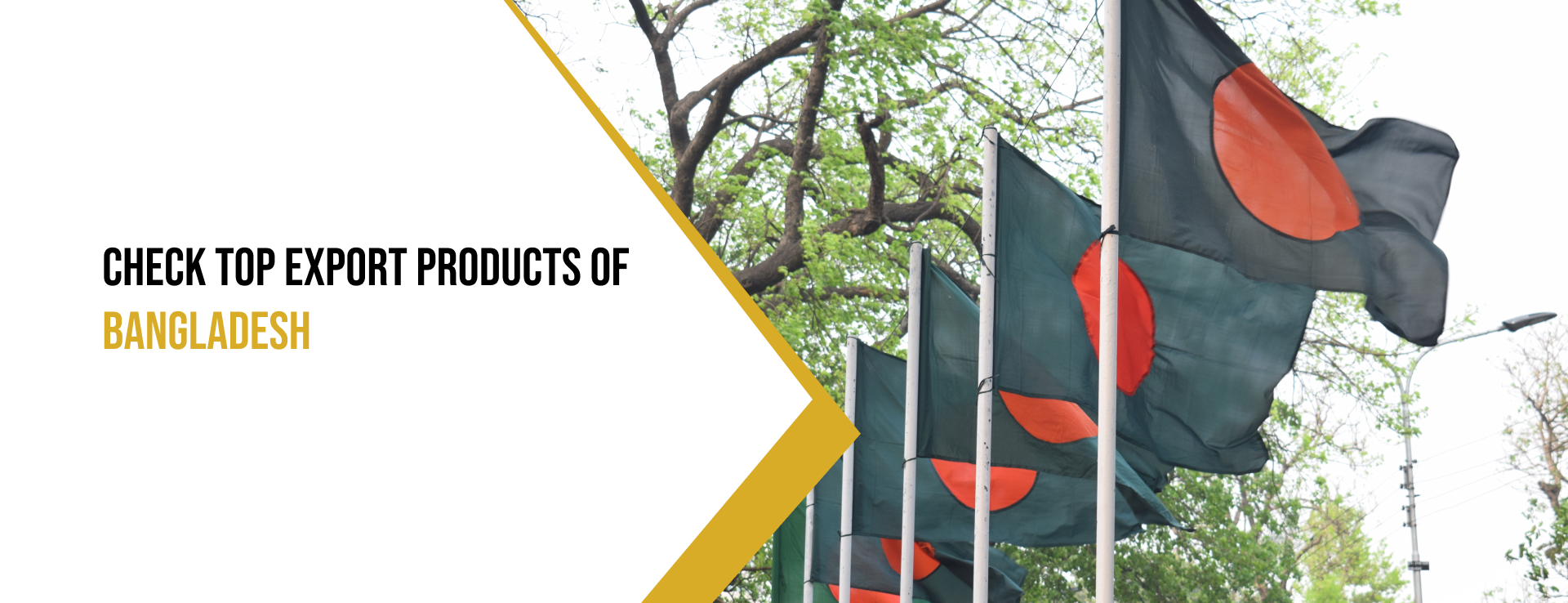

What Are the Top Export Products from Bangladesh Driving Trade in 2026?
Key Highlights:
-
Data is based on shipment-level export records for April 2025 - March 2026
-
Bangladesh's total merchandise exports hit $48.28 billion in FY2025 which is 8.55% more than previous year
-
Knitted apparel (HS 61) leads at $22.19 billion
-
The top two categories - knitwear and woven apparel account for over 80% of total export earnings
Get Access to Bangladesh Trade Data
There's a good chance that one of the cotton t-shirts or polo shirts you got was made in Dhaka, Gazipur, or Chittagong because Bangladesh produces a very large share of the world's clothing. But what is even more fascinating is what lies behind this headline. Because the story of Bangladesh's export in 2026 is not only about garments anymore, as it's widening into multiple in-demand sectors too.
Bangladesh's export economy now also includes footwear, leather goods, seafood, plastics, and several emerging industrial sectors. Still, textiles continue to dominate the landscape by a very large margin. And while garments remain the engine behind the country’s export machine, they’ve also opened the door for other manufacturing sectors to scale.
That's the part worth digging into. The statistical figures of Bangladesh's exports for the period of April 2025 to March 2026 tell a more layered story than most people realise. The nation that created the world's second-largest apparel sector almost from scratch, and is now quietly building around it.
Overview of Bangladesh’s Export Economy in 2026
Bangladesh isn't a rising export economy anymore. It's a major global apparel-based exporter.
Total merchandise export earnings hit $48.28 billion in FY25, up 8.55% from the year before. Exports contribute roughly 12 to 14% of the country's GDP - and that figure understates the real economic weight, because garment and textile manufacturing alone employs tens of millions of people, the majority of them women who entered the formal workforce through this industry.
The Bangladesh trade industry is no longer purely a garment story. Engineering products are reaching new bench marks in export value. Pharmaceuticals are building a real presence in over 150 export markets. IT-enabled services are growing in ways that don't even appear in merchandise trade statistics. The Bangladesh export economy is still dominated by apparel. But the edges are widening. And that widening matters for anyone tracking Bangladesh's position in global supply chains.
Top 10 Export Products of Bangladesh (April 2025 - March 2026)
The following list comes from shipment-level Bangladesh export data for April 2025 to March 2026. They're drawn from actual trade records, ranked by export value in USD. One thing stands out immediately: the top two categories alone account for over $37 billion. Here's what the top 10 export products of Bangladesh look like:
| HS Code | Description | Value(USD) |
| 61 | Knitted Apparel | $22.19B |
| 62 | Woven Apparel | $18.86B |
| 63 | Other Made-up Textile Articles | $1.42B |
| 64 | Footwear | $1.32B |
| 84 | Machinery and Mechanical Equipment | $840.20M |
| 53 | Vegetable Textile Fibers (including Jute) | $772.61M |
| 42 | Leather and Leather Articles | $514.15M |
| 87 | Vehicles Other Than Railway | $505.18M |
| 39 | Plastics and Articles Thereof | $450.42M |
| 03 | Fish and Seafood (Frozen) | $408.03M |
Now let's go through each one - because the numbers alone don't tell the whole story.
Knitted Apparel (HS 61)
This category is the biggest export of Bangladesh. Anything knitted or worn in the t-shirts, polo shirts, sweatshirts, hoodies, leggings comes under this. The country exported goods worth $22.19 billion between April 2025 and March 2026 where EU and USA showed strong demand.
What makes this category so dominant isn't just low labor cost - it's the supply chain density. Bangladesh has integrated yarn spinners, knitting mills, dyeing houses, finishing units, and packaging facilities which operate within tightly connected industrial zones. Buyers get competitive pricing and faster lead times. That combination is genuinely hard to replicate in countries that are newer to garment manufacturing.
Woven Apparel (HS 62)
If knitwear is Bangladesh's biggest export, woven apparel is its oldest backbone.
Trousers, dress shirts, jackets, chinos, formal suiting - these are the structured, cut-and-sewn garments that require a different set of skills and equipment than knitwear. Bangladesh built expertise here first, before knitwear overtook it in recent years. European buyers, in particular, have long-standing sourcing relationships in this category. Together, HS 61 and 62 account for well over 80% of Bangladesh's total export earnings.
Other Made-up Textile Articles (HS 63)
Almost a billion dollars from bed sheets, towels, curtains, and pillowcases.
Home textiles don't carry the profile of apparel, but this category is nearly at the $1.42 billion mark - and it's getting there because of a very specific global sourcing shift. North American and European retailers who built their home textile supply chains around Chinese factories have been diversifying. Bangladesh offers the right combination of price, compliance certification, and production capacity to absorb a portion of that redirected demand.
Footwear (HS 64)
For more than ten years, Bangladesh has consistently been expanding its footwear export industry. The industry went through this growth mainly through the investment in leather processing, mainly the tannery infrastructures, which are the main suppliers of both footwear and leather goods industries. Germany, Italy, Japan, and South Korea mainly import from this sector. The product portfolio of the sector includes finished leather shoes, synthetic footwear, and sandals.
At $1.32 billion, Bangladesh isn't in Vietnam's league on footwear yet. But the growth has been consistent, the quality has improved, and buyers who started small sourcing trials here have largely kept coming back. It's the kind of quiet sector that shows up as a surprise on export data reports.
Machinery and Mechanical Equipment (HS 84)
Machinery and mechanical equipment at $840.20M isn’t what most buyers associate with Bangladesh, but it makes more sense when you focus on what’s actually being exported. A significant share includes industrial parts, textile processing equipment components, jute processing machinery, agricultural tools, and light industrial units that have built up around Bangladesh's manufacturing clusters over decades.
What makes this segment notable is not scale alone, but its export capability. Bangladesh’s engineering sector has been expanding, with a combination of small and mid-sized manufacturers producing cost-effective machinery suited for basic industrial use. While the country doesn’t compete with advanced manufacturing hubs yet, it offers practical solutions for businesses that prioritize value over high-end specialization.
Vegetable Textile Fibers Including Jute (HS 53)
Jute was Bangladesh's original export identity, long before garments took over. It continues to grow and export more jute than almost anywhere else in the world. Be it raw fiber, spun yarn, and finished goods like sacks, bags, ropes, and floor coverings, you can import everything mentioned. China, India, and Pakistan are the main buyers of raw and semi-processed jute. Europe buys more finished jute products, particularly for eco-friendly packaging and home decor.
There’s a strong case that Bangladesh’s jute sector is still underperforming its potential. Rising global demand for biodegradable alternatives to single-use plastics has created favourable conditions for jute - a strong, affordable, and naturally abundant crop in Bangladesh - even though structural inefficiencies continue to hold the sector back.
Leather and Leather Articles (HS 42)
Bangladesh has spent years enhancing the value of its leather industry. Instead of concentrating on producing raw hides and wet-blue leather for exports, it has now shifted focus to manufacturing finished products such as bags, wallets, belts, gloves, and accessories. The major part of that transformation was relocating tanneries from Hazaribagh, one of the world's most polluted industrial areas, to the newly established Leather Industrial City with proper effluent treatment facilities. The change was slow but it became more and more necessary as European buyers required higher environmental standards.
Vehicles Other Than Railway or Tramway Rolling-Stock (HS 87)
Bangladesh’s vehicle exports sit at $505.18M between April 2025 to March 2026. This category isn’t passenger car exports, but is driven primarily by three-wheelers, CNG auto-rickshaws, and light commercial vehicles, along with auto parts and components. Bangladesh has developed a meaningful assembly and parts manufacturing base around these vehicle types, particularly for low-cost urban transport solutions.
The interesting angle here is how Bangladesh's domestic vehicle market shaped this export. Three-wheelers and CNG vehicles became dominant in Bangladesh's cities because they're practical and affordable. Local manufacturers who built capacity to supply that domestic demand gradually built the cost base and production volume to compete in export markets. The demand was already established in the domestic market before these products entered new markets.
Plastics and Articles Thereof (HS 39)
Plastic products crossing $450 million is a signal worth noting.
Packaging materials, household goods, and light industrial components make up the bulk of this category. It's not a headline export, and it doesn't get talked about in coverage of Bangladesh's major exports. But it reflects something important: Bangladesh's manufacturing base is slowly expanding beyond textiles and leather. The same cost advantages that built the garment industry apply here too.
Fish and Frozen Seafood (HS 03)
Bangladesh exports significant volumes of frozen shrimp, prawns, fish, and crustaceans. While the EU (Germany, the Netherlands, Belgium, and France) is the primary buyer, accounting for a substantial share of exports. Other than the EU, the US and Japan are also among the leading markets for Bangladesh’s seafood exports.
This sector has had a complicated history. EU food safety audits flagged contamination and hygiene issues in Bangladeshi seafood processing facilities in earlier years, leading to import restrictions that hurt earnings. The recovery since then has been real but gradual. Processing standards have improved, and Bangladesh has worked to meet the compliance requirements of regulated markets.
Wrapping Up
Bangladesh's biggest exports in 2026 are still dominated by garments. The top two categories alone - knitted and woven apparel hold for more than $40 billion in annual exports. But the story has more pages now than it used to. Footwear has crossed a billion dollars. Home textiles are approaching it. Leather goods are recovering. Plastics are growing. Pharmaceuticals are building a genuine international presence. Top 10 export products of Bangladesh in 2026 reflect a broader industrial base than the country had a decade ago.
Businesses that stay ahead in the Bangladesh export market typically rely on import-export data providers that go beyond headline statistics. Tools such as EX-IM by The Dollar Business show you individual shipment records, buyer patterns, emerging product trends, and much more crucial details, which are helpful in global trade markets.
If you’re looking for shipment-level Bangladesh export data and global trade intelligence that helps sourcing and make faster, better-informed decisions, then EX-IM is for you. Book a demo with us today and track real-time trade data.
Frequently Asked Questions:
1. What is Bangladesh's top export in 2026?
The top export of Bangladesh in 2026 is knitted apparel standing at nearly $22.19 billion.
2. Which countries are Bangladesh's biggest export destinations?
The US, Germany, the UK, Spain, France, and the Netherlands top the list of Bangladesh export destinations.
3. Where can I find Bangladesh export data for trade research?
Shipment-level Bangladesh export data including buyer details, HS codes, port information, and volume trends is available on out trade intelligence platforms EX-IM by The Dollar Business.
Also Read: Top Imports of Bangladesh
Recent Blogs
Best Products to Export Based on Global Demand 2026
Discover best products to export in 2026 based on global demand and market opportunities Identify highdemand products and top export markets

India’s Import Export Data: Everything You Need to Know in 2026
Trade data isn't just numbers Discover how Indian businesses use importexport data to find buyers track competitors and much more in 2026
CIF vs FOB vs EXW Explained for Beginners
CIF vs FOB vs EXW explained for beginners learn what each Incoterm means who pays for what and when risk transfers in international shipping