
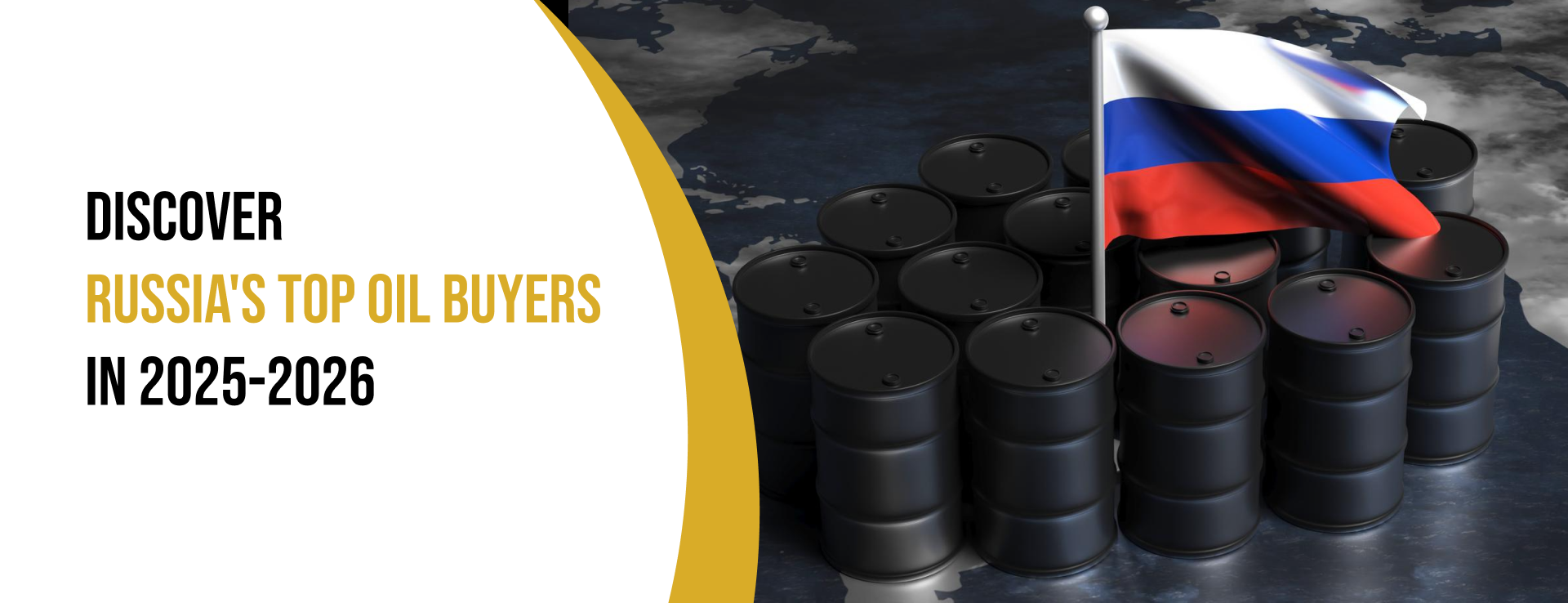

Russian Oil Exports by Country: Who Buys the Most?
Key Highlights:
-
HSN code of Russian oil is 2710.
-
Verified trade records shows Russia exported more oil under HSN code 2709 to Asia in 2025 than before the war.
-
India leads the Russian oil imports with a value of $26,671,429,743.49 in April 2025 to March 2026.
-
Russian crude oil quality, bulk availability, and stabilizing nature supply make it important in global energy markets.
-
Kazakhstan, itself a major oil producer imports $1.95 million Russian refined products.
Russian Oil Exports By Country: Who Depends Most? Top 3 Importers & Trends
After the Russia-Ukraine War, Russia faced the toughest sanctions imposed in modern history, yet it still managed to export volumes of oil to Asia. These heavy measures were made to limit its trade, freeze assets, and to cap the oil prices. Yet In 2025, Russia exported more oil with HSN code 2709 to Asia than before the war. This surprising pattern shows that despite restrictions, there are several countries who remain the major oil importers. Understanding Russian oil exports by country helps you track who depends most on Russian crude, and how global trade flows are shifting.
Who Are The Top 3 Russian Oil Importers?
Based on the trade intelligence tool that shows April 2025 to March 2026 data, below are the three countries which stand out as the leading destinations for Russian oil exports:
|
Country |
Import Value (April 2025 - March 2026) |
|
India |
$26,671,429,743.49 |
|
Uzbekistan |
$916,773,170.40 |
|
Kazakhstan |
$1,946,304.87 |
There are many reasons oil importers from these countries buy crude oil from Russia, but the major one is the cost gap. Russian crude often comes at a discount when compared to other sources which means it makes an attractive option for countries looking to reduce energy costs. But price alone does not explain the continuity of these trade relationships, each country has its own unique dependency.
India
India is not just the largest importer of Russian oil in this dataset but also imports 30 times more oil than the other two countries when combined. Standing at $26.67 billion in the last 13 months, India's purchases show a structural transformation in its refinery sector that began in 2022 and has now become strongly integrated. Indian refineries which are particularly at Jamnagar, Vadinar, and state-owned plants across the country were modified to process Russian crude oil. This helps India to purchase oil at a 15-25% lower price compared to global standards like Brent. By 2024, Russia had become India's single largest crude supplier.
Uzbekistan
The total oil import value of Uzbekistan from Russia during April 2025 to March 2026 is $916.77 million. Here, the main dependency is driven more due to location than the cost. However, it’s true that Uzbekistan does produce some oil itself, but its refinery capacity and growing domestic energy demand significantly exceed local production. This makes Russian imports a bare minimum necessity rather than a short-term purchase for Uzbekistan. And with the $916 million figure over 13 months represents consistent, stable purchasing rather than the cost-driven increase seen in more flexible markets. For Russia, Uzbekistan is a reliable smaller market that is legal, stable, and simple.
Kazakhstan
At $1.95 million, Kazakhstan is not a major importer of Russian oil by value, but its presence on the list is notable because Kazakhstan is itself a significant oil producer. Kazakhstan imports specific Russian oil products, primarily refined grades for domestic consumption in its northern regions, where Russian supply is logistically closer and cheaper than domestic product shipped from its own southern refineries. This regional balancing dynamic is common among energy producers with geographically uneven refinery distribution.
Why Is Russian Crude Oil Export Important In Global Trade?
Russian crude oil holds a unique position in the oil ecosystem because of its different qualities:
- Its heavy and medium-sour grades suit complex refineries
- Its bulk availability allows purchasers to skip small scale sellers.
- Russian petroleum exports act as a buffer during any disruptions which stabilizes the supply chain.
How Trade Intelligence Drives Revenue Growth In Russian Oil Trade?
In concentrated commodity markets like Russian oil, revenue is rarely driven by volume alone as it is driven by timing, margin opportunity, and buyer intelligence. Trade intelligence platforms such as EX-IM by The Dollar Business help you identify the right market and scale them with profit that manual efforts can’t do. This tool helps to find where demand is concentrating, which are new purchasers, and how prices shift across regions. When you track these details, your business can scale in the import-export market like never before. Hence, understanding the difference between reacting to trade flows and predicting them directly impacts commercial outcomes. That’s where trade intelligence tools come into play enabling a shift from reactive analysis to smarter, revenue-focused strategies for your business.
The latest Russian oil exports by country statistics clearly shows that sanctions may change trade routes but not demand. Buyers like India show long-term dependence, while countries like Uzbekistan and Kazakhstan depend on regional and short-term needs. Therefore, future trade will be shaped more by demand, pricing, and logistics. As markets become more concentrated, understanding buyer behavior and dependency patterns will be key to tracking global energy supply.
Frequently Asked Questions (FAQs)
1. What is the HSN code for Russian oil?
The HSN code of Russian oil is 2709 and is for petroleum oils and oils extracted from bituminous minerals.
2. Who is India's biggest buyer of Russian oil?
India’s biggest Russian oil importer is Reliance industries with a total value of $8,581,408,555.08 between April 2025 to March 2026.
3. Who is Russia's largest oil exporter?
Rosneft is the largest oil exporter with a total value of $7,577,654,651.68 between April 2025 to March 2026. It accounts for approximately 40% of the country’s total oil production.
4. Why does Kazakhstan import oil from Russia if it is already a major producer?
Kazakhstan imports Russian oil mainly for regional logistics because its northern refineries are more cost-effectively which are supplied by nearby Russian pipelines.
Recent Blogs
What Does Bangladesh Import the Most in 2026?
Discover Bangladesh top import products during April 2025 to March 2026 Also explore the top importers countries import value HS Code and more
What Are the Top Export Products from Vietnam in 2026?
Discover Vietnam's top export products in 2026 by HS code value and market Also understand what's driving Vietnam's $475B export economy
What Are the Top Export Products from Sri Lanka in 2026?
Discover the top export products from Sri Lanka in 2026 from apparel and tea to coconut goods rubber gems and much more